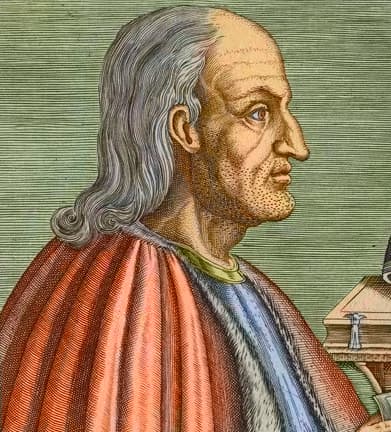
Anselm of Canterbury
'Faith seeking understanding'; invented the ontological argument for God.
Overview
A Benedictine monk, archbishop of Canterbury, and the 'father of Scholasticism', Anselm sought to demonstrate the truths of faith by reason alone — 'faith seeking understanding'. In the Proslogion he devised the ontological argument: that God, 'that than which nothing greater can be conceived', must exist in reality, since to exist in reality is greater than to exist in the mind alone. He also gave an influential rational account of the Atonement.
What they supported — and why
Faith seeking understanding
SupportedBelieve first, then use reason to understand what faith holds.
WhyFaith supplies the starting point, and reason deepens and confirms it — 'I believe so that I may understand.'
The ontological argument
SupportedGod is that than which nothing greater can be conceived; such a being must exist in reality, for a God existing in reality is greater than one existing only in thought.
WhyTo conceive the greatest possible being while denying its existence is a contradiction, since real existence is a greater perfection.
A rational theology of the Atonement
SupportedWhy God became man (Cur Deus Homo) can be shown by reason: an infinite offense against God required an infinite satisfaction only a God-man could pay.
WhyThe logic of divine justice and honor explains the necessity of the Incarnation without mere appeal to authority.
Causes championed
- Proving faith by reason
- The rational necessity of God
- Systematic theology
Issues wrestled with
- Can God's existence be proven a priori?
- Why did God become man?
- How do faith and reason relate?
Hurdles faced
- Twice exiled amid conflict with English kings over church authority
- The monk Gaunilo's early objection to his argument
Works & books
3 catalogued. Status shows how much survives to today.
Proslogion
SurvivesContains the ontological argument for God's existence.
Monologion
SurvivesA rational meditation on the divine nature.
Cur Deus Homo (Why God Became Man)
SurvivesHis rational account of the Incarnation and Atonement.
Read the texts free
Their works online — Open Library catalogues 121 works & editions, 16 of them free to read in full.
The influence network
See Anselm of Canterbury in the map →In their words
“I do not seek to understand in order that I may believe, but I believe in order that I may understand.”
— Proslogion
Legacy
The founder of Scholastic method and author of the ontological argument — still debated by philosophers nine centuries later.
Follow their questions
This thinker is a stop on these paths through philosophy.
Further reading
Cross-checked against these authoritative references.