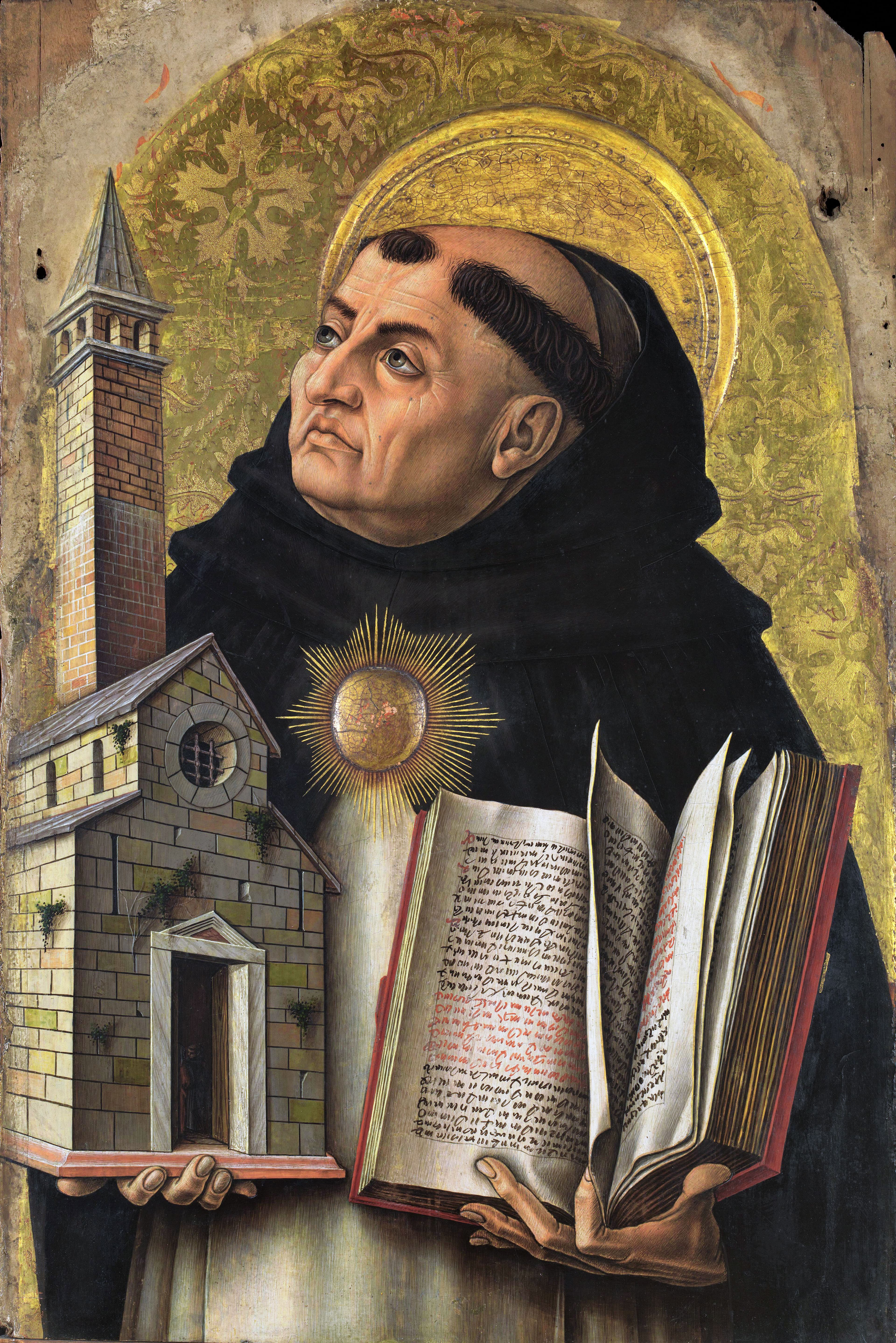
Thomas Aquinas
Synthesized Aristotle with Christianity — the towering system of Scholasticism (Thomism).
Overview
A Dominican friar and the greatest of the Scholastics, Aquinas achieved a monumental synthesis of Aristotelian philosophy and Christian theology. In the Summa Theologiae and Summa contra Gentiles he argued that faith and reason are distinct but harmonious, that God's existence can be demonstrated by reason (the Five Ways), and that grace perfects rather than destroys nature. His system, Thomism, became the semi-official philosophy of the Catholic Church.
What they supported — and why
Faith and reason harmonize; grace perfects nature
SupportedReason and revelation are distinct routes to a single truth, and grace builds on and completes nature rather than negating it.
WhyBoth come from God and so cannot conflict; nature is good and is elevated, not abolished, by grace.
The Five Ways
SupportedGod's existence can be demonstrated from motion, causation, contingency, degrees of perfection, and the governance of things.
WhyFeatures of the world — change, causal order, contingency — require a first cause, God, to explain them.
Natural law ethics
SupportedThere is a natural moral law, knowable by reason, grounded in the ends of human nature and ultimately in God's eternal law.
WhyRational creatures can grasp the goods proper to their nature, and directing action toward them is the moral law.
Being and analogy
SupportedGod is being itself (ipsum esse); creatures exist by participation, and we speak of God analogically.
WhyOnly God's essence is to exist; creatures receive being, so God-talk is neither univocal nor equivocal but analogical.
Causes championed
- The synthesis of Aristotle and Christianity
- The demonstrability of God
- Natural law
- The goodness of reason and of nature
Issues wrestled with
- Can God's existence be proven?
- How do faith and reason relate?
- What grounds morality?
- What is being?
Hurdles faced
- Church suspicion of Aristotelianism (some Thomist theses were condemned in 1277, soon after his death)
- His family's opposition to his joining the friars
Works & books
3 catalogued. Status shows how much survives to today.
Summa Theologiae
PartialHis systematic masterwork on God, creation, ethics, and Christ; left unfinished at his death.
Summa contra Gentiles
SurvivesA reasoned defense of Christian truth addressed to non-believers.
On Being and Essence; commentaries on Aristotle
SurvivesFoundational metaphysics and extensive commentary on the Aristotelian corpus.
Read the texts free
4 of Thomas Aquinas’s works are free to read in full — public-domain English editions on Project Gutenberg, matched from Gutenberg’s own catalogue.
Every edition online — Open Library catalogues 2,099 works & editions, 224 of them free to read in full.
The influence network
See Thomas Aquinas in the map →Influenced
In their words
“We can know that God is, but not what God is.”
— Summa Theologiae (paraphrase)
“Grace does not destroy nature but perfects it.”
— Summa Theologiae
Legacy
The central figure of Scholasticism, whose synthesis remains the backbone of Catholic philosophy and a landmark of Western thought.
Follow their questions
This thinker is a stop on these paths through philosophy.
Further reading
Cross-checked against these authoritative references.