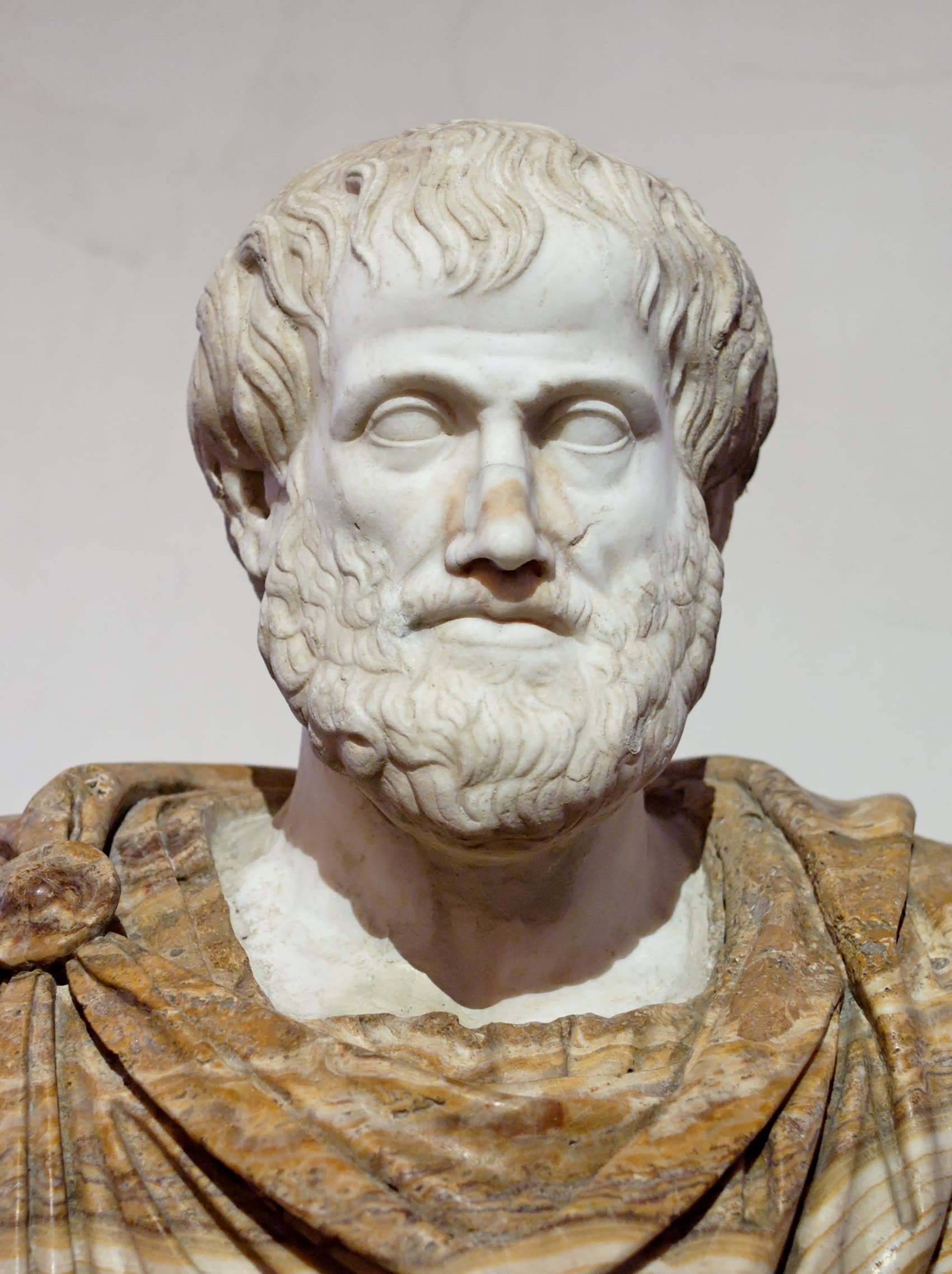
Aristotle
The systematizer of everything — logic, nature, ethics, politics.
Overview
Aristotle studied under Plato for twenty years, tutored Alexander the Great, and founded the Lyceum. Where Plato looked to a separate realm of Forms, Aristotle located form within things and made careful empirical observation central. He effectively invented formal logic, systematized biology, physics, metaphysics, ethics, politics, rhetoric, and poetics, and coined much of the vocabulary of Western thought. His ethics centers on eudaimonia (flourishing) achieved through virtue as a mean and the exercise of reason. Roughly a third of his output survives — mostly lecture notes.
What they supported — and why
Form is in things (hylomorphism)
SupportedEvery substance is a compound of matter and form; form is not in a separate realm but immanent.
WhyWe explain a thing by what it is made of and what it is — Plato's separate Forms are unnecessary and cannot explain change.
The four causes
SupportedTo know a thing fully is to know its material, formal, efficient, and final cause (its end/purpose).
WhyComplete explanation must include what something is for; nature acts toward ends (teleology).
Virtue as the golden mean
SupportedMoral virtue is a disposition to choose the mean between excess and deficiency (courage between rashness and cowardice).
WhyRight action fits the situation; virtue is a trained, rational habit aiming at the appropriate response.
Eudaimonia through reason
SupportedThe human good is flourishing — activity of the soul in accordance with virtue over a complete life.
WhyA thing's good lies in fulfilling its characteristic function; ours is rational activity done well.
Syllogistic logic
SupportedValid reasoning can be formalized in syllogisms (All A are B; all B are C; so all A are C).
WhyArgument has a structure independent of content, so validity can be studied systematically — the birth of logic.
Causes championed
- Empirical study of the natural world
- Systematic knowledge across all fields
- The life of reason and virtue
Issues wrestled with
- What is substance and change?
- What is the good life?
- How should states be organized?
- What makes reasoning valid?
Hurdles faced
- Breaking from his revered teacher Plato
- Fled Athens near the end 'lest it sin twice against philosophy' amid anti-Macedonian feeling
Works & books
7 catalogued. Status shows how much survives to today. 3 can be read free in full — look for “Read free”.
Nicomachean Ethics
SurvivesHis theory of virtue, the mean, friendship, and eudaimonia — the foundational work of virtue ethics.
Read free — full texthere →Politics
SurvivesAnalysis of constitutions, citizenship, and 'man as a political animal'.
Read free — full texthere →Metaphysics
SurvivesOn being qua being, substance, potentiality/actuality, and the Unmoved Mover.
Physics
SurvivesNature, motion, causation, time, and place.
Organon (logical works)
SurvivesPrior/Posterior Analytics, Categories, and more — the founding texts of formal logic.
Poetics
PartialTheory of tragedy, plot, and catharsis; the section on comedy is lost.
Read free — full texthere →De Anima (On the Soul)
SurvivesThe soul as the form of a living body; perception and intellect.
Read the texts free
8 of Aristotle’s works are free to read in full — public-domain English editions on Project Gutenberg, matched from Gutenberg’s own catalogue.
Every edition online — Open Library catalogues 1,230 works & editions, 165 of them free to read in full.
The influence network
See Aristotle in the map →In their words
“We are what we repeatedly do. Excellence, then, is not an act, but a habit.”
— paraphrase of the Nicomachean Ethics
“Man is by nature a political animal.”
— Politics
Legacy
For nearly two thousand years he was simply 'The Philosopher'; his logic, categories, and vocabulary still structure how the West thinks.
Essays
Pieces from the Journal that take up Aristotle in more depth.
Follow their questions
This thinker is a stop on these paths through philosophy.
Further reading
Cross-checked against these authoritative references.