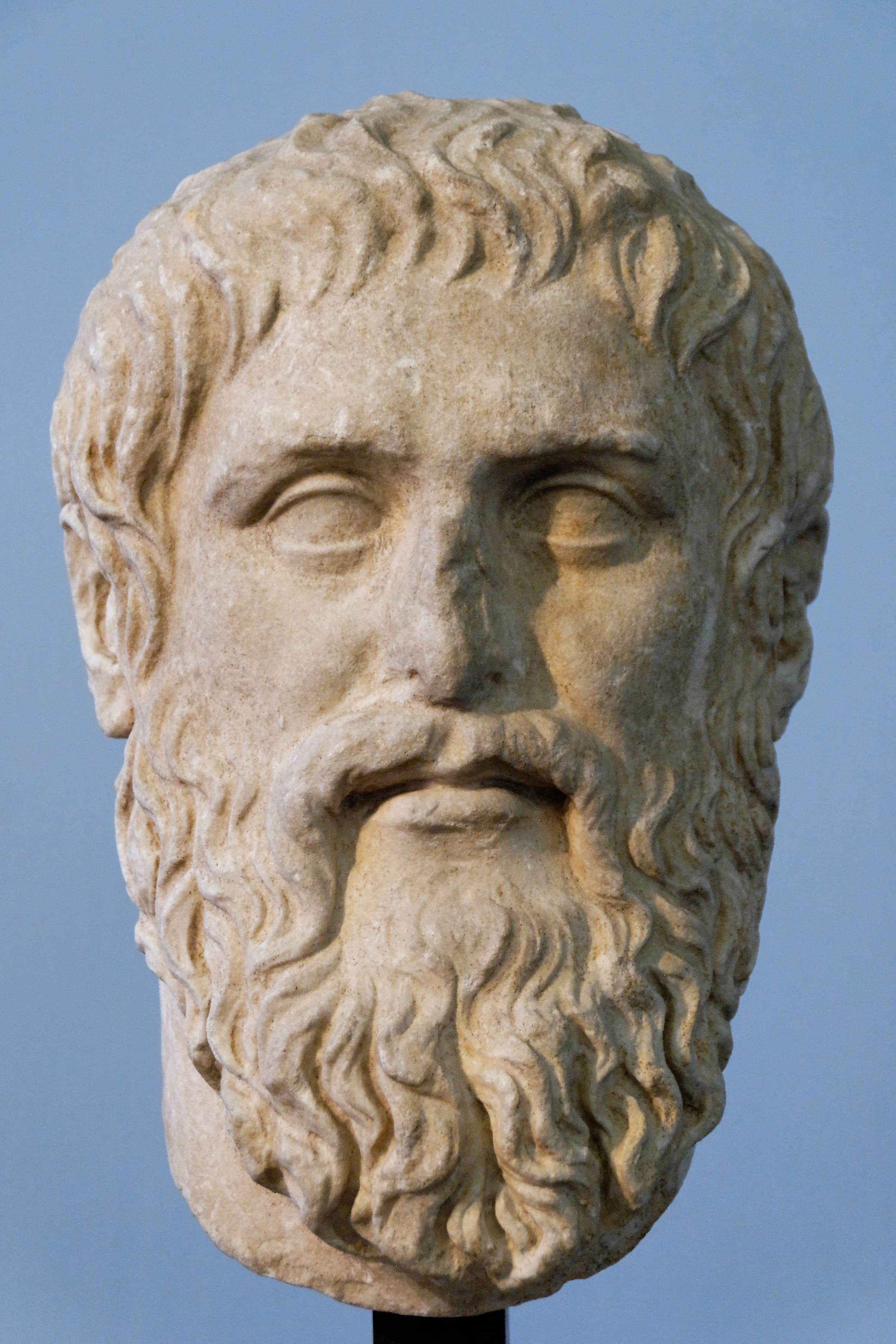
Plato
Reality lies in eternal Forms; founded the Academy and wrote the dialogues.
Overview
Plato, Socrates' greatest student, is among the most influential thinkers in history. Devastated by Socrates' execution, he wrote dialogues dramatizing philosophical inquiry and founded the Academy, the West's first enduring institution of higher learning. His Theory of Forms holds that the changing physical world is a shadow of eternal, perfect Forms grasped only by reason. He developed a tripartite theory of the soul, an argument for its immortality, and in the Republic a blueprint for a just city ruled by philosopher-kings. Whitehead called European philosophy 'a series of footnotes to Plato'.
What they supported — and why
The Theory of Forms
SupportedBeyond the physical world lie eternal, non-material Forms (Justice itself, Beauty itself); particular things are imperfect copies.
WhyKnowledge must have stable, perfect objects; changing sensible things cannot ground it, so real objects of knowledge must be the Forms.
The tripartite soul
SupportedThe soul has reason, spirit, and appetite; justice is their proper harmony under reason.
WhyInner conflict shows the soul has parts; virtue is their right ordering, mirroring a just city.
Philosopher-kings
SupportedThe just city should be ruled by those who know the Form of the Good.
WhyOnly those who grasp the Good can govern for the whole rather than for faction or appetite.
The immortality of the soul
SupportedThe soul pre-exists and survives the body and can recollect the Forms.
WhyLearning is recollection of what the soul knew before birth, implying it is deathless and akin to the eternal Forms.
Causes championed
- Objective truth and moral realism
- Education and the founding of the Academy
- Rule by wisdom over rule by force or wealth
Issues wrestled with
- What is knowledge versus opinion?
- What is justice, in the soul and the city?
- What is the nature of reality and the Good?
Hurdles faced
- The trauma of Socrates' execution soured him on Athenian democracy
- His attempts to advise the tyrants of Syracuse ended in danger and failure
Works & books
7 catalogued. Status shows how much survives to today.
Republic
SurvivesHis masterwork on justice, the Forms, the tripartite soul, the philosopher-king, and the Allegory of the Cave.
Apology
SurvivesSocrates' defense speech at his trial — a manifesto for the examined life.
Phaedo
SurvivesSocrates' last day and arguments for the immortality of the soul.
Symposium
SurvivesSpeeches on the nature of love (erōs) and its ascent toward Beauty itself.
Timaeus
SurvivesA cosmology describing the craftsman-god (Demiurge) shaping the world after the Forms.
Meno
SurvivesWhether virtue can be taught; the theory of recollection.
Parmenides
SurvivesA rigorous self-critique of the Theory of Forms.
Read the texts free
27 of Plato’s works are free to read in full — public-domain English editions on Project Gutenberg, matched from Gutenberg’s own catalogue.
Every edition online — Open Library catalogues 3,737 works & editions, 421 of them free to read in full.
The influence network
See Plato in the map →Influenced by
In their words
“We are twice armed if we fight with faith.”
— attributed
“The heaviest penalty for declining to rule is to be ruled by someone inferior to yourself.”
— Republic
Legacy
He set the agenda of Western philosophy — metaphysics, epistemology, ethics, politics — and his Academy modeled the university for two millennia.
Essays
Pieces from the Journal that take up Plato in more depth.
Follow their questions
This thinker is a stop on these paths through philosophy.
Further reading
Cross-checked against these authoritative references.