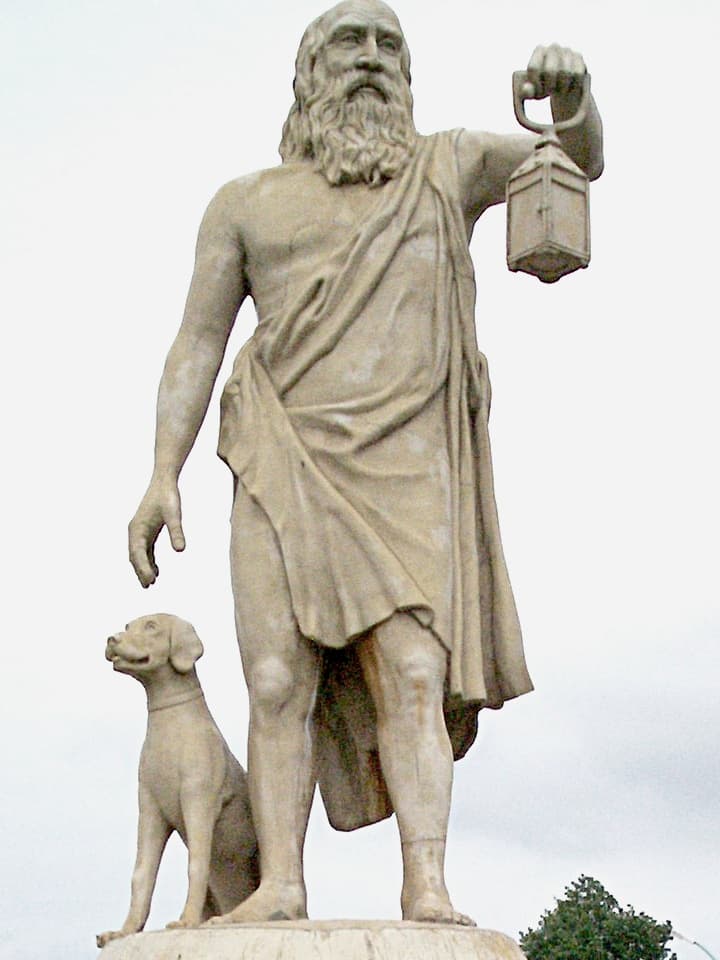
Diogenes of Sinope
The Cynic who lived in a jar and mocked every convention.
Overview
Diogenes made his life the argument. Exiled from Sinope, he lived in poverty in Athens and Corinth — reputedly in a large ceramic jar — owning almost nothing, begging, and performing shameless public acts to expose the arbitrariness of social convention. He held that virtue is shown in deeds, that happiness comes from satisfying only natural needs, and that shame and status are illusions. He called himself a 'citizen of the world' (kosmopolitēs). When Alexander the Great offered him anything, he asked only that the king stop blocking his sunlight.
What they supported — and why
Live according to nature
SupportedReduce needs to what nature actually requires; reject wealth, fame, and comfort as false goods.
WhyDesires beyond nature enslave us; the self-sufficient person who needs little is truly free.
Virtue is practiced, not theorized
SupportedGoodness is demonstrated through a rigorous, ascetic way of life, not abstract argument.
WhyEthics is training (askēsis); talk without a changed life is empty.
Cosmopolitanism
SupportedOne belongs to no single city but to the world; conventional identities are arbitrary.
WhyIf virtue is natural and universal, then local customs and citizenship carry no moral authority.
Causes championed
- Radical self-sufficiency (autarkeia)
- Exposing hypocrisy and empty convention
- Freedom of speech (parrhēsia)
Issues wrestled with
- What does nature really require of us?
- Is shame natural or conventional?
- What is genuine freedom?
Hurdles faced
- Exile from his home city
- Reportedly captured by pirates and sold into slavery
- Deliberate poverty and social scandal
Works & books
1 catalogued. Status shows how much survives to today.
(disputed writings)
LostVarious dialogues and a Republic are attributed to him but do not survive; his teaching came through anecdote and example.
The influence network
See Diogenes of Sinope in the map →Influenced by
Influenced
In their words
“Stand a little out of my sun.”
— reply to Alexander the Great, via Diogenes Laërtius
“I am a citizen of the world.”
— via Diogenes Laërtius
Legacy
Cynicism's demand to live in accord with nature and to unmask convention fed directly into Stoicism and echoes in every later ascetic and anti-materialist movement.
Further reading
Cross-checked against these authoritative references.