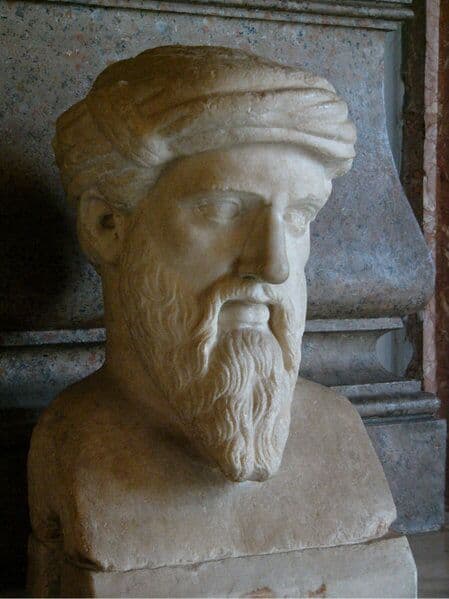
Pythagoras
Number is the essence of reality; founded a mystical mathematical brotherhood.
Overview
Pythagoras founded a religious and philosophical community at Croton in southern Italy that combined mathematics, music, cosmology, and a strict way of life. The Pythagoreans discovered that musical harmony corresponds to simple numerical ratios, and generalized this into the claim that number underlies all things. They believed in the transmigration of souls (reincarnation) and practiced purification through study and discipline. Because the community was secretive and attributed discoveries to Pythagoras himself, separating the man from the school is difficult.
What they supported — and why
All is number
SupportedThe nature and structure of things is fundamentally mathematical; ratios and proportions govern reality.
WhyMusical harmony reduces to whole-number ratios (2:1 octave, 3:2 fifth); if harmony is number, perhaps everything is.
Transmigration of the soul
SupportedThe soul is immortal and is reborn into new bodies across lives.
WhyThe soul is divine and distinct from the body; ethical purification determines its fate across incarnations.
Harmony of the cosmos
SupportedThe heavens move in mathematical order — the 'harmony of the spheres'.
WhyIf number governs music and the cosmos alike, the universe is an ordered, beautiful whole (a kosmos).
Causes championed
- Mathematics as the key to reality
- Ascetic purification and community life
- Vegetarianism and reverence for life
Issues wrestled with
- What is the deep structure of nature?
- What is the fate of the soul?
- How should a philosophical community live?
Hurdles faced
- Political backlash destroyed the Croton community
- Secrecy and legend obscured his actual teachings
Works & books
1 catalogued. Status shows how much survives to today.
(none)
LostPythagoras wrote nothing that survives; doctrines were transmitted orally and by later Pythagoreans and Neopythagoreans.
Read the texts free
1 of Pythagoras’s works are free to read in full — public-domain English editions on Project Gutenberg, matched from Gutenberg’s own catalogue.
Every edition online — Open Library catalogues 64 works & editions, 1 of them free to read in full.
The influence network
See Pythagoras in the map →Influenced by
Influenced
In their words
“Number is the ruler of forms and ideas, and the cause of gods and daemons.”
— attributed by later Pythagoreans
Legacy
The conviction that nature is written in the language of mathematics runs from Plato through Kepler, Galileo, and modern physics — a Pythagorean inheritance.
Essays
Pieces from the Journal that take up Pythagoras in more depth.
Further reading
Cross-checked against these authoritative references.