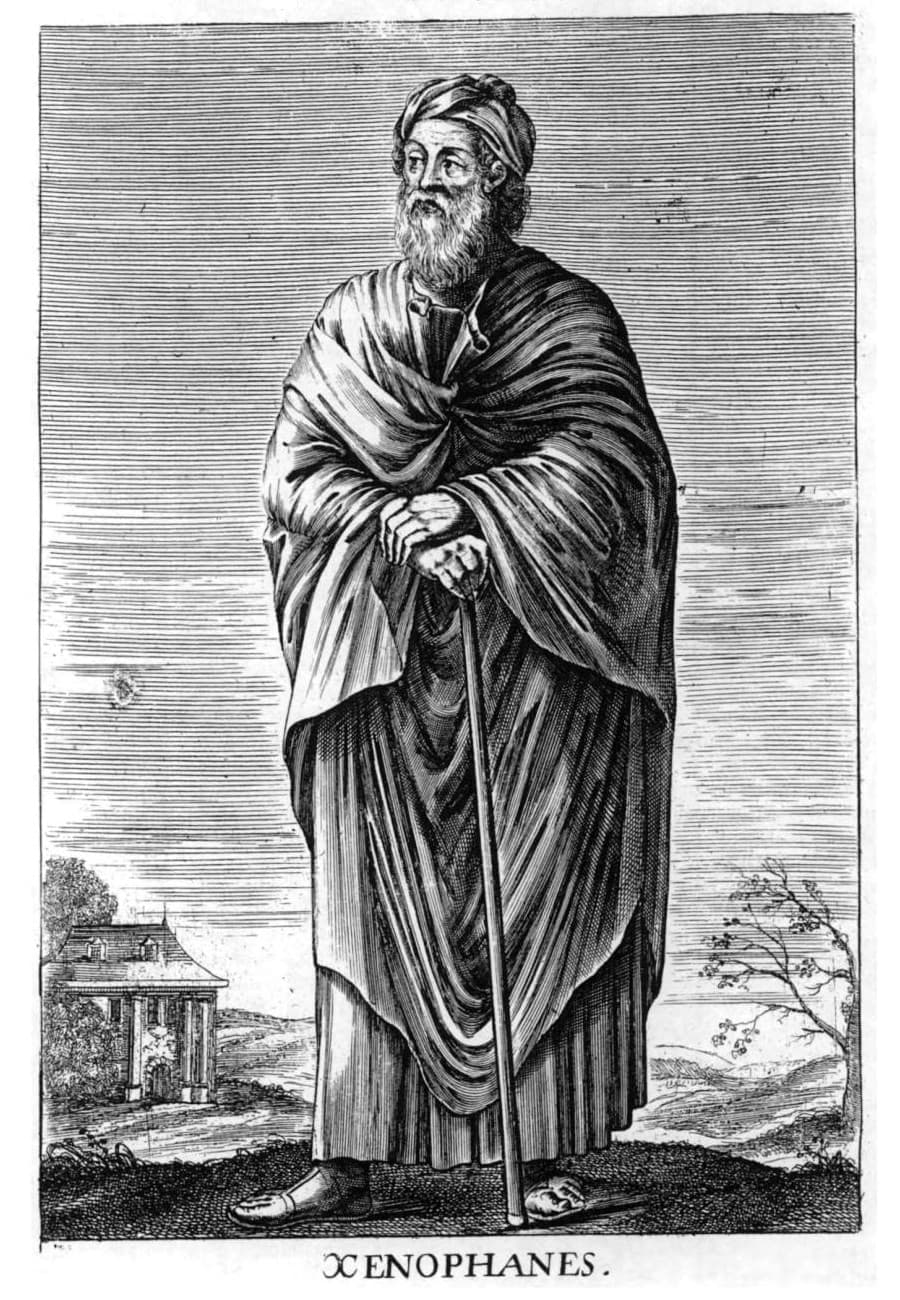
Xenophanes of Colophon
Mocked man-made gods; glimpsed one non-human God and the limits of knowledge.
Overview
A traveling poet-philosopher who wandered Greece for some sixty-seven years, Xenophanes was the first great critic of popular religion. He attacked Homer and Hesiod for portraying the gods as thieving, adulterous, and human in form, arguing that people simply imagine gods in their own image. In their place he proposed one greatest god — unlike mortals in body or thought — who governs all things by mind. He also voiced an early epistemology: certain truth about gods and nature is beyond human reach; we have only opinion.
What they supported — and why
Critique of anthropomorphism
SupportedThe gods of myth are human projections; if oxen and horses could draw, they would draw gods shaped like themselves.
WhyDifferent peoples imagine gods resembling themselves, revealing that such gods are inventions, not the truly divine.
One greatest God
SupportedThere is one god, greatest among gods and men, in no way like mortals in body or mind, who sees, thinks, and hears as a whole and moves all things by thought.
WhyPerfection and unity befit divinity far more than a squabbling, human-like pantheon.
The limits of knowledge
SupportedNo mortal has known or will know the certain truth about the gods and all things; even a lucky guesser would not know they had it right.
WhyHuman access to such matters is partial and unverifiable, so the honest attitude is opinion, not certainty.
Causes championed
- Honest theology over myth
- Intellectual humility
- Natural explanation of phenomena
Issues wrestled with
- What are the gods really like?
- Can humans attain certain truth?
- How did the natural world come to be?
Hurdles faced
- A lifetime of exile and wandering
- Attacking the revered authority of Homer and Hesiod
Works & books
2 catalogued. Status shows how much survives to today.
Elegies and Silloi (satirical verses)
Fragments onlyPoems criticizing anthropomorphic religion and Greek excess; survive as fragments.
On Nature
AttributedA cosmological poem attributed to him; its authenticity is debated and only fragments remain.
Read the texts free
Their works online — Open Library catalogues 10 works & editions, 2 of them free to read in full.
The influence network
See Xenophanes of Colophon in the map →Influenced by
Influenced
In their words
“If oxen and horses had hands, they would draw the forms of the gods like their own.”
— Fragment (DK B15)
“The gods did not reveal all things to men from the beginning; but by seeking they find in time what is better.”
— Fragment (DK B18)
Legacy
The first philosophical critic of religion and theologian of a single non-human God, he seeded both Eleatic monism and the epistemic humility later prized by the skeptics.
Further reading
Cross-checked against these authoritative references.