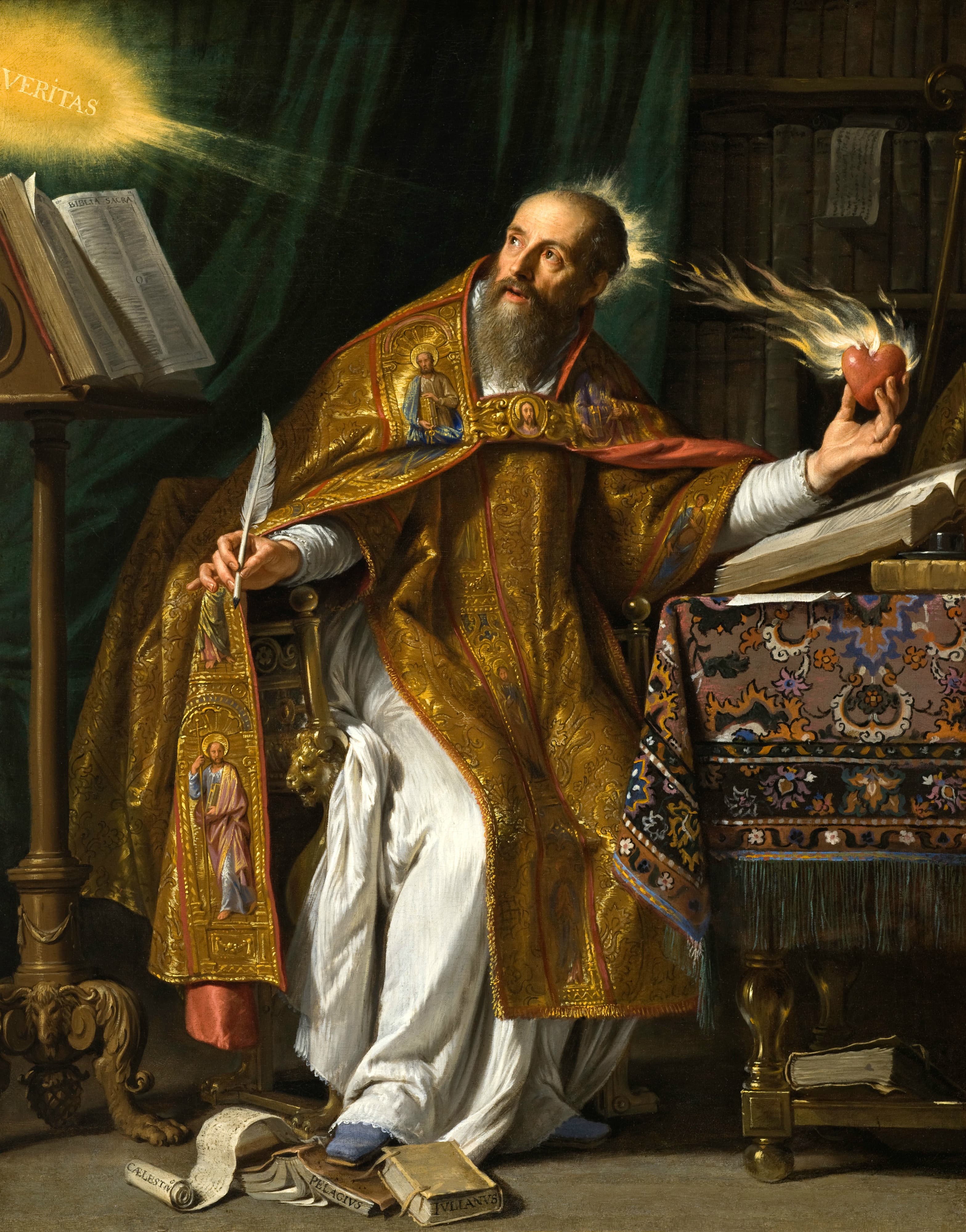
Augustine of Hippo
Aurelius Augustinus
Fused Christianity with Platonism and wrote the first great autobiography.
Overview
The most influential of the Latin Church Fathers, Augustine fused Christian doctrine with Neoplatonism and shaped Western theology and philosophy for a millennium. After a restless youth — recounted in the Confessions, the first true autobiography — he converted and became bishop of Hippo. He probed time, memory, the will, evil, language, and history, argued that truth is found by turning inward and then upward to God, and developed the doctrines of original sin, grace, and the 'two cities'. His thought underlies both Catholic and, later, Reformation theology.
What they supported — and why
Faith seeking understanding; the inner ascent to God
SupportedBelieve in order to understand; truth is reached by turning inward, then above the mind, to God.
WhyThe changeless truths the mind discovers within itself point beyond it to their eternal source, God.
Evil as privation, not a substance
SupportedEvil is not a thing but a privation or corruption of good; God did not create it.
WhyEverything God made is good, so evil must be a lack or a turning-away — which preserves both God's goodness and omnipotence.
Grace and the divided will
SupportedThe will is bound by sin and needs divine grace to choose the good; we feel an inner conflict of wills.
WhyHis own experience showed a will divided against itself, unable to save itself without grace.
The two cities
SupportedHistory is the interplay of the City of God (love of God) and the earthly city (love of self).
WhyHuman societies are shaped by what they love, so a sacred history runs beneath the visible political one.
Causes championed
- The harmony of faith and reason
- The interior spiritual life
- The primacy of grace
- A Christian philosophy of history
Issues wrestled with
- What is time?
- What is evil, and whence?
- Is the will free?
- How do the earthly and heavenly cities relate?
Hurdles faced
- A long inner struggle before his conversion
- The sack of Rome (410), which he answered in the City of God
- Controversies with Manichaeans, Donatists, and Pelagians
Works & books
3 catalogued. Status shows how much survives to today.
Confessions
SurvivesAutobiography and philosophy of memory, time, and the restless heart — the first of its kind (written c. 397–400).
City of God
SurvivesA vast Christian philosophy of history contrasting the earthly and heavenly cities.
On the Trinity; On Free Choice of the Will; On Christian Doctrine
SurvivesMajor works on the Trinity, freedom and evil, and the interpretation of scripture.
Read the texts free
5 of Augustine of Hippo’s works are free to read in full — public-domain English editions on Project Gutenberg, matched from Gutenberg’s own catalogue.
Every edition online — Open Library catalogues 2,306 works & editions, 192 of them free to read in full.
The influence network
See Augustine of Hippo in the map →In their words
“You have made us for yourself, O Lord, and our heart is restless until it rests in you.”
— Confessions
“Love, and do what you will.”
— Homilies on the First Epistle of John
Legacy
The bridge from ancient philosophy to Christian Europe; his synthesis of Plato and scripture defined Western thought for over a thousand years.
Follow their questions
This thinker is a stop on these paths through philosophy.
Further reading
Cross-checked against these authoritative references.