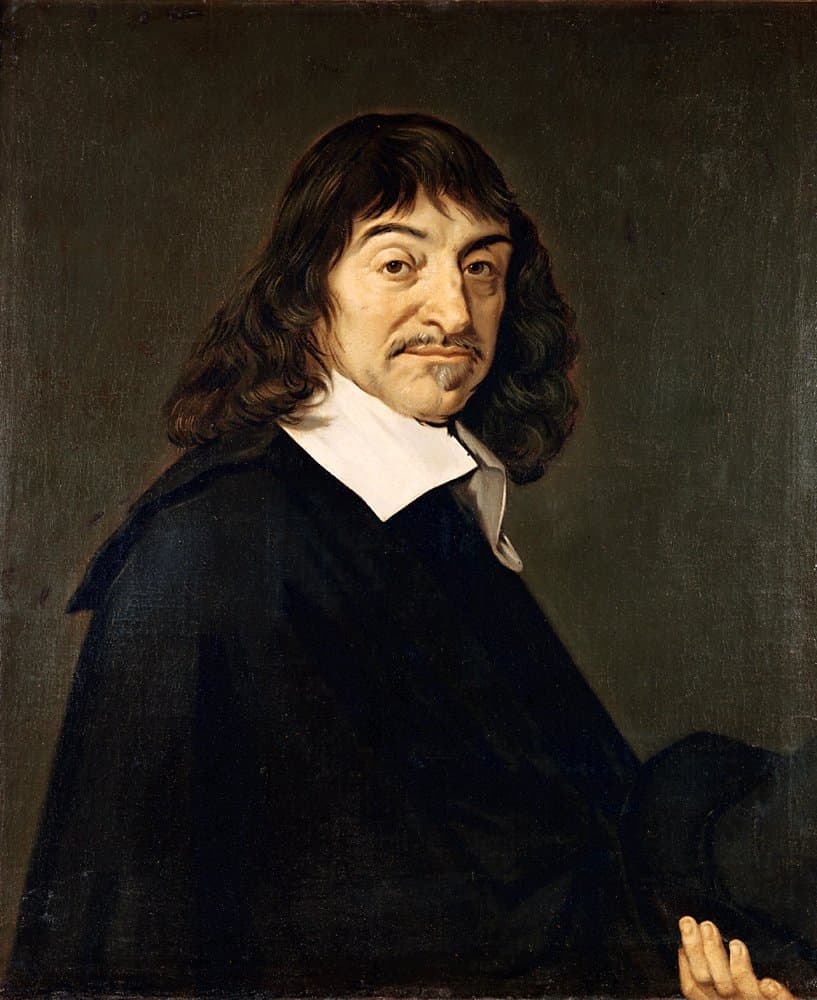
René Descartes
Father of modern philosophy — 'I think, therefore I am' and methodic doubt.
Overview
Widely called the father of modern philosophy, the French rationalist and mathematician Descartes sought certain knowledge by doubting everything that could possibly be doubted. He found bedrock in the one thing he could not doubt — that he was thinking — and built outward: 'I think, therefore I am.' From the certainty of the thinking self and a proof of a non-deceiving God, he tried to reground knowledge and defended a sharp dualism of mind and body. He also invented analytic geometry, uniting algebra and geometry.
What they supported — and why
Methodic doubt
SupportedDoubt everything that can possibly be doubted — the senses, the external world, even mathematics (via a possible deceiving demon) — to find an indubitable foundation.
WhyTo build knowledge securely, one must first clear away everything uncertain and start from what cannot be doubted at all.
The cogito
Supported'I think, therefore I am' — even a deceived mind must exist in order to be deceived, so the existence of the thinking self is certain.
WhyThe very act of doubting proves a doubter, giving one absolutely certain truth as the foundation for the rest of knowledge.
Mind–body dualism
SupportedMind (thinking, unextended substance) and body (extended, mechanical substance) are really distinct.
WhyThe self is known with certainty as a thinking thing while the body's existence is doubted, so mind and matter must be different kinds of substance.
Causes championed
- Certain, foundational knowledge
- The autonomy of reason
- A mechanistic understanding of nature
Issues wrestled with
- What can be known with certainty?
- What is the self?
- How do mind and body relate?
Hurdles faced
- The Church's condemnation of Galileo led him to withhold some views
- The unsolved problem of how immaterial mind interacts with material body
Works & books
2 catalogued. Status shows how much survives to today.
Meditations on First Philosophy
SurvivesHis central work on doubt, the cogito, God, and the mind–body distinction.
Discourse on the Method
SurvivesHis accessible statement of method (and 'I think, therefore I am'), prefacing his scientific essays.
Read the texts free
4 of René Descartes’s works are free to read in full — public-domain English editions on Project Gutenberg, matched from Gutenberg’s own catalogue.
Every edition online — Open Library catalogues 808 works & editions, 73 of them free to read in full.
The influence network
See René Descartes in the map →In their words
“I think, therefore I am.”
— Discourse on the Method
Legacy
He set the agenda of modern philosophy — the primacy of the subject, the quest for certainty, and the mind–body problem still debated today.
Follow their questions
This thinker is a stop on these paths through philosophy.
Further reading
Cross-checked against these authoritative references.