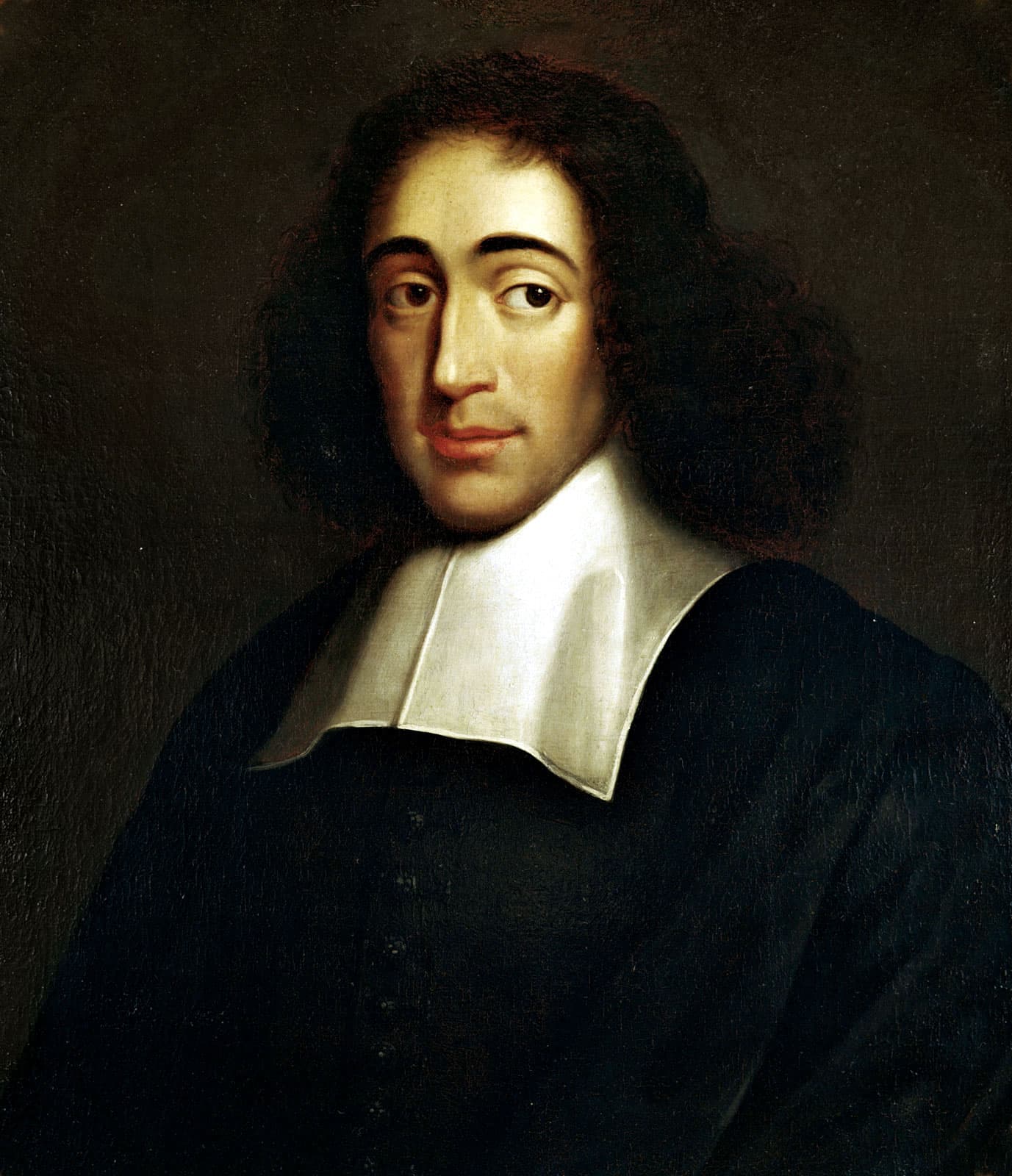
Baruch Spinoza
Rationalist of the one substance — God-or-Nature, and freedom through understanding.
Overview
A Dutch rationalist of Portuguese-Jewish descent, excommunicated by his community for his radical views, Spinoza ground lenses for a living and wrote one of philosophy's boldest systems. In the Ethics, set out in geometric form, he argued that there is only one infinite substance — 'God or Nature' (Deus sive Natura) — of which everything is a mode. All events are necessary; mind and body are two aspects of the same reality. Freedom and blessedness come not from escaping necessity but from understanding it. He also pioneered secular biblical criticism and liberal politics.
What they supported — and why
One substance — God or Nature
SupportedThere exists only one infinite substance, God or Nature; all particular things are modes (modifications) of it.
WhyA truly infinite, self-caused substance leaves nothing outside it, so everything must be an expression of the one reality, not separate creations.
Necessity and the two attributes
SupportedEverything follows necessarily from the nature of God; mind and body are not two things but one reality grasped under the attributes of thought and extension.
WhyAs a triangle's properties follow from its nature, all events follow necessarily; and since substance is one, the mental and physical are parallel aspects of it.
Freedom through understanding (blessedness)
SupportedWe are not free from the causal order, but we become free and blessed by understanding it and loving God/Nature intellectually.
WhyBondage is being driven by passions we don't understand; grasping their necessity calms them and yields the highest, active joy.
Causes championed
- A fully rational, unified cosmos
- Freedom of thought and toleration
- Ethics grounded in understanding, not fear
Issues wrestled with
- What is the ultimate nature of reality?
- Are we free in a necessary world?
- How should we live and find blessedness?
Hurdles faced
- Excommunicated (herem) by the Amsterdam Jewish community at 23
- Denounced as an atheist; he declined a professorship to keep his freedom, and published the Ethics only after death
Works & books
2 catalogued. Status shows how much survives to today.
Ethics
SurvivesHis geometrically-argued masterwork on God, mind, the passions, and human freedom (published posthumously).
Theological-Political Treatise
SurvivesA pioneering defense of freedom of thought, secular politics, and critical Bible scholarship.
Read the texts free
Their works online — Open Library catalogues 891 works & editions, 75 of them free to read in full.
The influence network
See Baruch Spinoza in the map →In their words
“Do not weep; do not wax indignant. Understand.”
— attributed, summarizing his ethics
Legacy
His vision of a single rational Nature, and of freedom as understanding, made him a hero of the Enlightenment and modern naturalism.
Follow their questions
This thinker is a stop on these paths through philosophy.
Further reading
Cross-checked against these authoritative references.