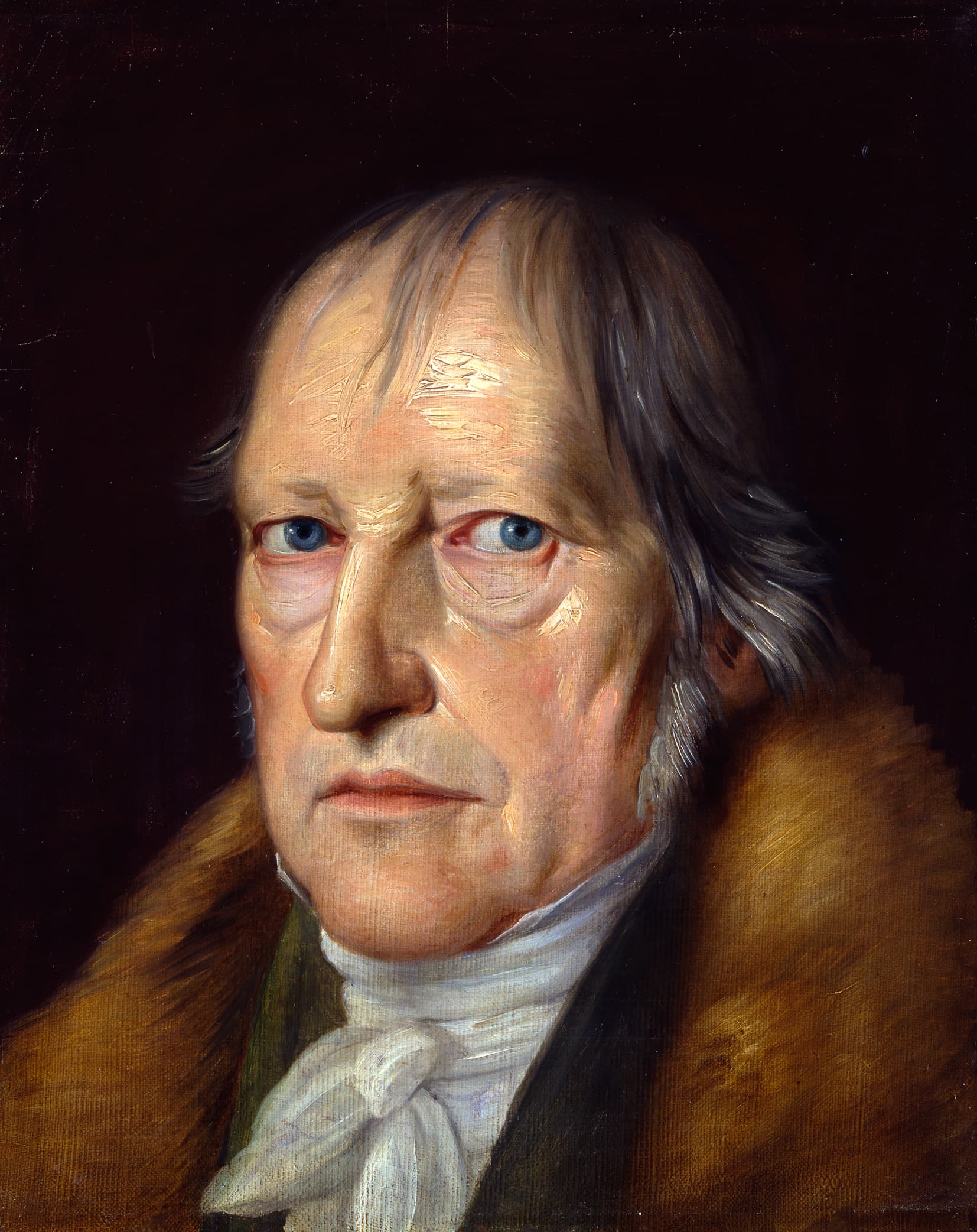
G. W. F. Hegel
Georg Wilhelm Friedrich Hegel
German Idealist of the dialectic — reality and history as the unfolding of Spirit.
Overview
The towering figure of German Idealism, Hegel built a vast system in which reality, thought, and history are the self-development of 'Spirit' (Geist) coming to know itself. His dialectical method — the movement through contradiction to a higher synthesis — and his view of history as the progress of freedom shaped philosophy, politics, and theology; Marx, the existentialists, and much of continental thought define themselves in relation to him.
What they supported — and why
The dialectic
SupportedThought and reality advance through contradiction: a position generates its opposite, and both are resolved (aufgehoben) in a higher unity that preserves and transcends them.
WhyReality is not static but a rational process, so understanding must follow the movement by which concepts and history overcome their own one-sidedness.
The Absolute and Spirit (Geist)
SupportedAll of reality is the self-unfolding of a single rational whole, Spirit, coming progressively to self-consciousness.
WhyOnly if the real is ultimately rational and one can thought fully know it; 'the rational is the actual and the actual is the rational'.
History as the progress of freedom
SupportedWorld history is the development of the consciousness of freedom, realized in ethical institutions and the state.
WhyFreedom is not mere caprice but rational self-determination achieved through social and historical life, unfolding over time.
Causes championed
- A complete rational system
- The reconciliation of reason and reality
- Freedom realized in history and community
Issues wrestled with
- How do thought and reality develop?
- What is the whole of reality?
- What is the meaning of history?
Hurdles faced
- Notoriously difficult prose and system
- Later attacked from all sides (Kierkegaard, Marx, the analytic tradition)
Works & books
2 catalogued. Status shows how much survives to today.
Phenomenology of Spirit
SurvivesThe dialectical journey of consciousness toward absolute knowing (including the master–slave dialectic).
Science of Logic; Elements of the Philosophy of Right
SurvivesHis logic of concepts and his philosophy of law, ethics, and the state.
Read the texts free
Their works online — Open Library catalogues 1,234 works & editions, 83 of them free to read in full.
The influence network
See G. W. F. Hegel in the map →Influenced
In their words
“The owl of Minerva spreads its wings only with the falling of the dusk.”
— Philosophy of Right
Legacy
The last great system-builder, whose dialectic and philosophy of history became the pivot that Marxism, existentialism, and continental thought turned on.
Follow their questions
This thinker is a stop on these paths through philosophy.
Further reading
Cross-checked against these authoritative references.