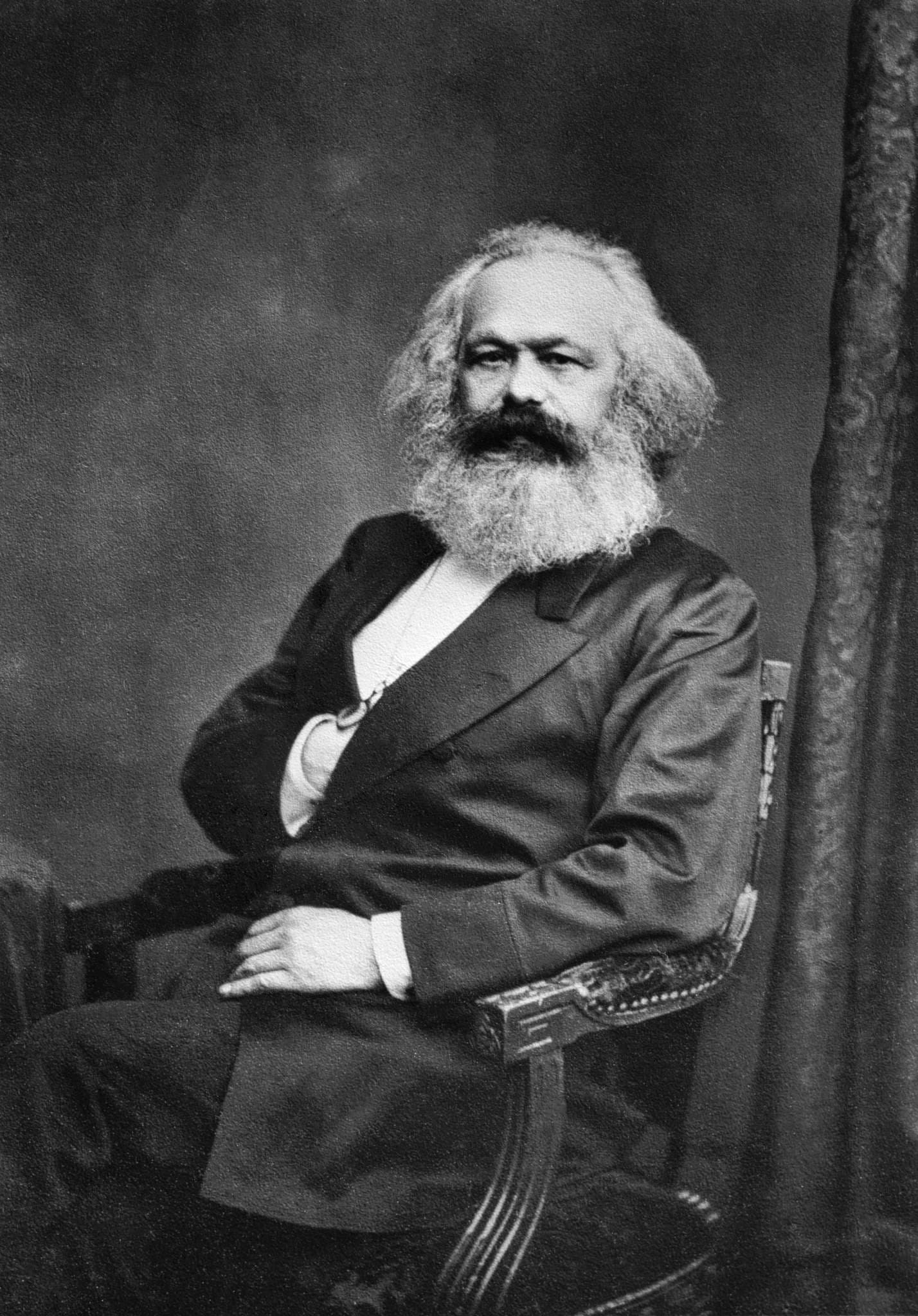
Karl Marx
Historical materialist and critic of capital — 'the point is to change it.'
Overview
Philosopher, economist, and revolutionary, Marx turned Hegel's dialectic toward material life, arguing that the economic organization of society shapes its politics, law, and ideas. He analyzed capitalism as a system driven by class conflict and the exploitation and alienation of labor, and predicted its supersession by a classless society. Though his political legacy is fiercely contested, his critique of capital and his materialist theory of history transformed philosophy, economics, and social science.
What they supported — and why
Historical materialism
SupportedThe material, economic base of a society — its forces and relations of production — fundamentally shapes its politics, law, and ideas (the 'superstructure').
WhyPeople must produce to live, so the way production is organized conditions everything else; ideas do not float free of material conditions.
Class struggle and the critique of capitalism
SupportedHistory advances through class conflict; capitalism exploits workers by extracting surplus value and concentrates wealth while immiserating labor.
WhyBecause owners profit from labor they do not perform, capitalism embeds a structural antagonism that drives crisis and, Marx argued, its own eventual overthrow.
Alienation and human emancipation
SupportedUnder capitalism workers are alienated from their labor, its products, others, and their own nature; true freedom lies in a classless society where people flourish.
WhyWhen work is coerced and its products appropriated, human creative activity is deformed; emancipation means reorganizing society so labor becomes free self-realization.
Causes championed
- The emancipation of labor
- A materialist, scientific understanding of society
- The critique of exploitation and alienation
Issues wrestled with
- What drives historical change?
- How does capitalism work, and whom does it serve?
- What would human freedom really require?
Hurdles faced
- Poverty and exile (stateless, he settled in London)
- State censorship; his later political appropriations distorted his thought
Works & books
2 catalogued. Status shows how much survives to today.
Capital (Das Kapital)
SurvivesHis systematic critique of political economy and the capitalist mode of production.
The Communist Manifesto (with Engels); Economic and Philosophic Manuscripts
SurvivesHis revolutionary program and his early theory of alienation.
Read the texts free
6 of Karl Marx’s works are free to read in full — public-domain English editions on Project Gutenberg, matched from Gutenberg’s own catalogue.
Every edition online — Open Library catalogues 2,063 works & editions, 46 of them free to read in full.
The influence network
See Karl Marx in the map →In their words
“The philosophers have only interpreted the world; the point is to change it.”
— Theses on Feuerbach
Legacy
One of the most influential thinkers in history: his materialist theory of history and critique of capital reshaped philosophy, the social sciences, and world politics.
Follow their questions
This thinker is a stop on these paths through philosophy.
Further reading
Cross-checked against these authoritative references.