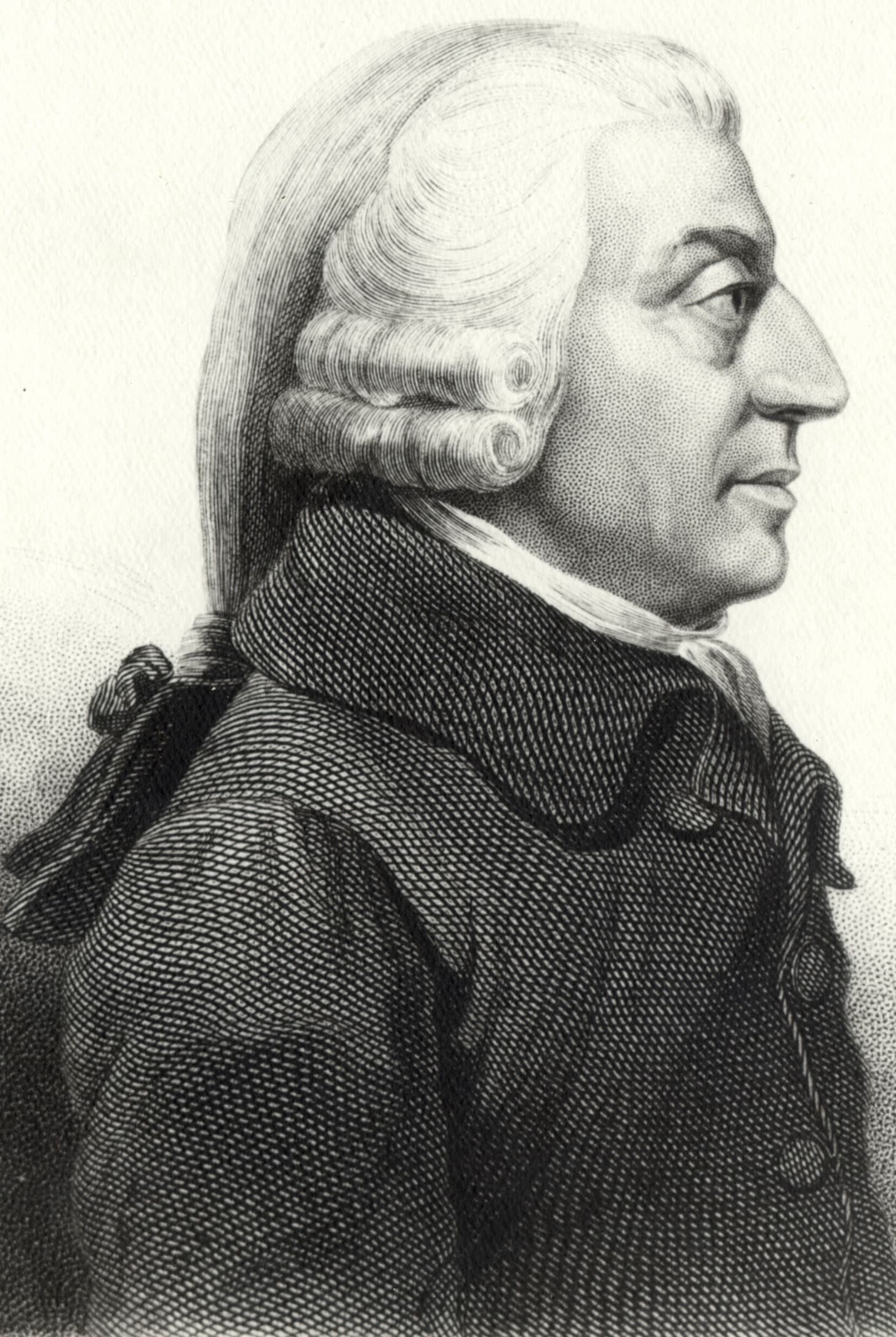
Adam Smith
Moral philosopher of sympathy and the 'invisible hand' of the market.
Overview
A central figure of the Scottish Enlightenment, Smith was a moral philosopher before he was the founder of modern economics. In The Theory of Moral Sentiments he grounded morality in sympathy and the judgement of an internalized 'impartial spectator'. In The Wealth of Nations he analyzed how, in a system of natural liberty, individuals pursuing their own interest are led 'as by an invisible hand' to promote the good of society, and how the division of labor and free exchange create prosperity. His two works together form a rich moral and social vision.
What they supported — and why
Sympathy and the impartial spectator
SupportedMoral judgement arises from sympathy — imaginatively sharing others' feelings — refined by viewing our conduct as a fair, impartial spectator would.
WhyWe approve of what an impartial onlooker could go along with, so morality is rooted in our social, sympathetic nature rather than pure reason or self-interest.
The invisible hand
SupportedIn a system of natural liberty, individuals pursuing their own gain are often led, unintentionally, to benefit society as a whole.
WhyFree exchange coordinates dispersed self-interest into mutual benefit, so many social goods emerge without central design.
The division of labor and free markets
SupportedSpecialization and free exchange vastly increase productivity and wealth.
WhyDividing work lets people specialize and improve, and open markets let their surpluses be exchanged, multiplying the wealth of nations.
Causes championed
- A moral philosophy of sympathy
- Economic liberty and prosperity
- The natural harmony of a free society
Issues wrestled with
- Where do moral judgements come from?
- How does a free economy coordinate self-interest?
- What creates the wealth of nations?
Hurdles faced
- Reconciling the moral and economic sides of his thought (the so-called 'Adam Smith problem')
- Being reduced, later, to a caricature of pure market advocacy
Works & books
2 catalogued. Status shows how much survives to today.
The Theory of Moral Sentiments
SurvivesHis moral philosophy of sympathy and the impartial spectator.
The Wealth of Nations
SurvivesThe founding work of modern economics — the division of labor, markets, and the invisible hand.
Read the texts free
3 of Adam Smith’s works are free to read in full — public-domain English editions on Project Gutenberg, matched from Gutenberg’s own catalogue.
Every edition online — Open Library catalogues 695 works & editions, 56 of them free to read in full.
The influence network
See Adam Smith in the map →Influenced by
Influenced
In their words
“It is not from the benevolence of the butcher, the brewer, or the baker that we expect our dinner, but from their regard to their own interest.”
— The Wealth of Nations
Legacy
He founded modern economics while grounding it in a moral philosophy of sympathy — a fuller thinker than his 'invisible hand' caricature.
Further reading
Cross-checked against these authoritative references.