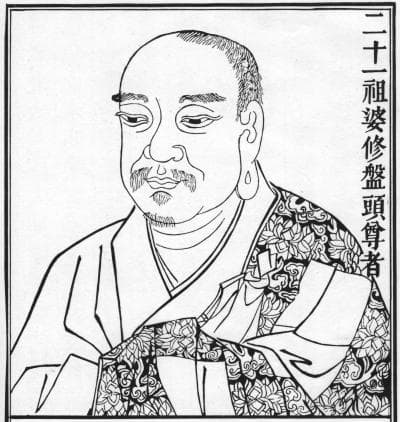
Vasubandhu
Co-founder of Yogācāra — 'consciousness-only' Buddhist idealism.
Overview
A towering Buddhist philosopher who, with his half-brother Asaṅga, developed the Yogācāra ('Yoga practice') or 'Consciousness-only' (Vijñānavāda) school of Mahāyāna. After an earlier career in the Abhidharma — his encyclopedic Abhidharmakośa remains a classic — he turned to Yogācāra and argued that our experienced world is a transformation of consciousness: the external objects we grasp are mental constructions. He analyzed the 'storehouse consciousness' (ālaya-vijñāna) that carries karmic seeds.
What they supported — and why
Consciousness-only (vijñapti-mātra)
SupportedThe world as we experience it is a manifestation of consciousness; the objects we grasp as external are constructed by the mind.
WhyDreams and illusions show experience can occur without external objects, and our grasping of a subject–object duality is itself a mental construction.
The storehouse consciousness (ālaya-vijñāna)
SupportedA deep substratum of consciousness stores karmic 'seeds' that ripen into experience.
WhyIt explains the continuity of karma and personality across moments and lives without positing a permanent self.
The three natures
SupportedPhenomena can be seen as imagined (constructed duality), dependent (the flow of conditioned mind), and perfected (emptiness of the constructed).
WhyDistinguishing these clarifies how illusion arises and how liberation — seeing the perfected nature — becomes possible.
Causes championed
- The analysis of consciousness
- The path from illusion to awakening
- Systematic Buddhist psychology
Issues wrestled with
- Is the external world independent of mind?
- How does karma continue without a self?
- How does illusion arise?
Hurdles faced
- Reconciling his earlier Abhidharma realism with Yogācāra idealism
- The subtlety of a 'mind-only' doctrine easily misread
Works & books
2 catalogued. Status shows how much survives to today.
Abhidharmakośa (Treasury of Abhidharma)
SurvivesHis classic encyclopedic summary of Abhidharma Buddhist philosophy.
Twenty Verses and Thirty Verses
SurvivesThe concise founding texts of Yogācāra 'consciousness-only'.
The influence network
See Vasubandhu in the map →In their words
“All this is consciousness-only, because of the appearance of non-existent objects.”
— Twenty Verses
Legacy
His 'consciousness-only' analysis is one of the world's great idealist philosophies and shaped Buddhist thought across Asia.
Further reading
Cross-checked against these authoritative references.