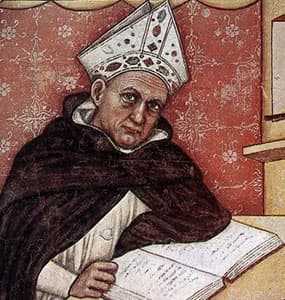
Albertus Magnus
The 'Universal Doctor' who brought Aristotle and empirical science into Christendom.
Overview
A Dominican of vast learning, Albert the Great set out to make the whole of Aristotle intelligible to the Latins, commenting on nearly all his works while drawing on the Arab philosophers. He was also a pioneering natural scientist and keen observer of plants, animals, and minerals. Teacher of Thomas Aquinas, he championed the compatibility of faith with Aristotelian reason and the value of studying nature in its own right.
What they supported — and why
Aristotle for Christendom
SupportedThe full range of Aristotelian philosophy and science can and should be assimilated into Christian learning.
WhyTruth is one, so the best pagan philosophy, rightly understood, serves rather than threatens faith.
Study nature by experience
SupportedNatural things should be investigated through observation and experience, not from books alone.
WhyThe aim of natural science is not to accept others' statements but to investigate the causes actually at work in nature.
Distinguish philosophy and theology
SupportedReason and revelation are distinct paths that reach one harmonious truth.
WhyEach has its own method and domain, so both can be pursued fully without conflict.
Causes championed
- The assimilation of Aristotle
- Empirical natural science
- The harmony of faith and reason
Issues wrestled with
- Can Aristotelian philosophy be reconciled with faith?
- How should nature be studied?
- How do reason and revelation relate?
Hurdles faced
- Suspicion of the newly arrived pagan and Arab learning
- The sheer labor of digesting the whole of Aristotle
Works & books
2 catalogued. Status shows how much survives to today.
Commentaries on Aristotle
SurvivesA vast project rendering nearly all of Aristotle intelligible to Latin readers.
On Minerals; On Animals; On Vegetables and Plants
SurvivesPioneering works of natural science based partly on direct observation.
Read the texts free
Their works online — Open Library catalogues 472 works & editions, 69 of them free to read in full.
The influence network
See Albertus Magnus in the map →Influenced
In their words
“The aim of natural science is to investigate the causes at work in nature.”
— On the Causes and Properties of the Elements
Legacy
He opened Christendom to the whole of Aristotle and to empirical inquiry — and trained the greatest of the Scholastics.
Further reading
Cross-checked against these authoritative references.