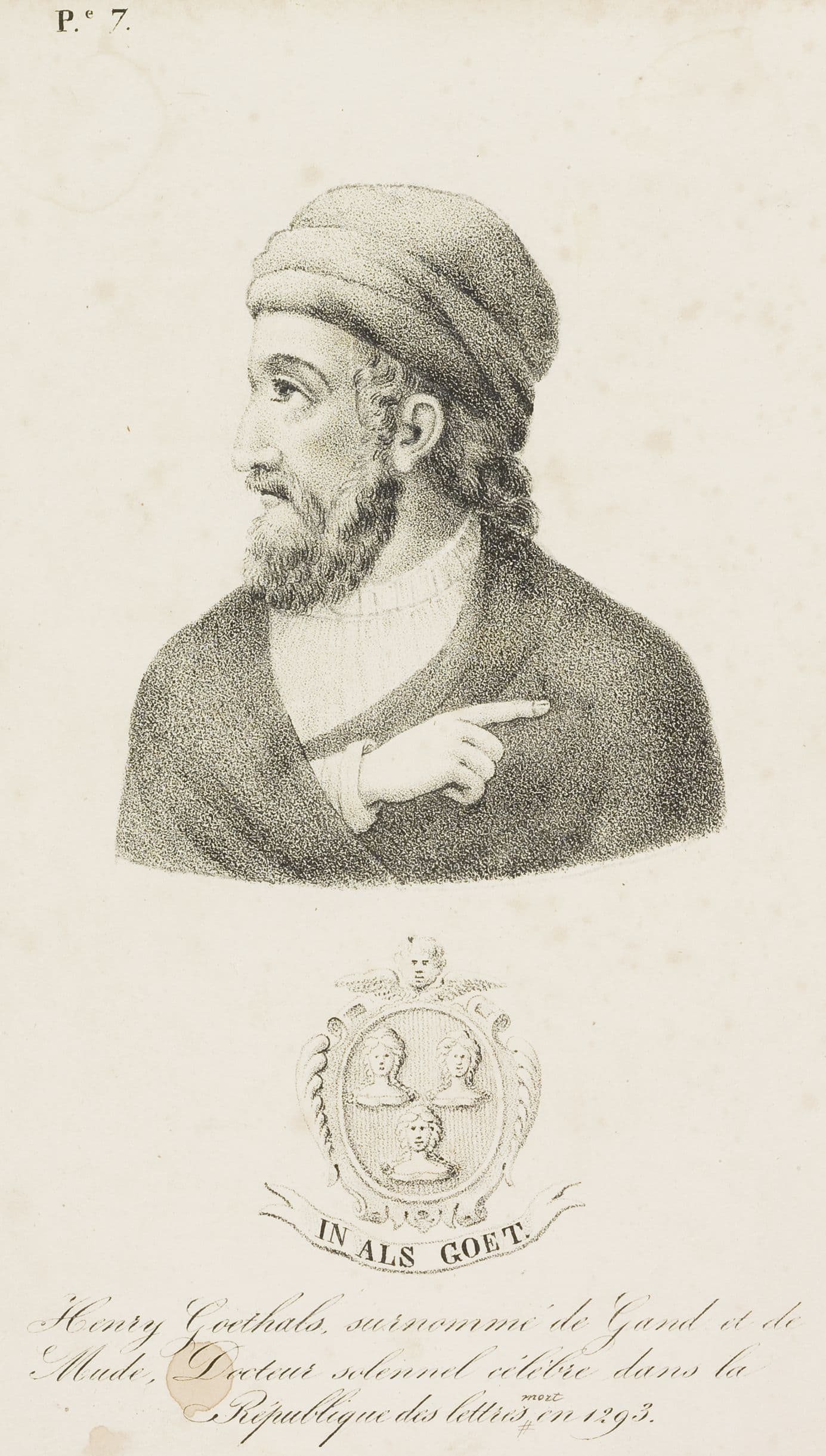
Henry of Ghent
The most influential master between Aquinas and Scotus; defender of divine illumination.
Overview
The leading secular master at Paris in the generation after Aquinas, Henry of Ghent built a subtle system blending Aristotle with Augustinian and Avicennian themes. He defended a form of divine illumination for the highest knowledge, distinguished essence and existence as an 'intentional' distinction, and gave metaphysics a central place. His positions were the immediate foil and stimulus for Duns Scotus.
What they supported — and why
Divine illumination for pure truth
SupportedCertain, unchanging truth requires God's special illumination beyond ordinary abstraction.
WhyThe mind's natural concepts, drawn from changeable things, cannot alone secure the certainty of the highest truths.
The reality of essences
SupportedA thing's essence has a being of its own (esse essentiae), distinct 'intentionally' from its existence.
WhyEssences are intelligible and grounded in the divine ideas, so they possess a reality prior to actual existence.
The primacy of metaphysics and the will
SupportedMetaphysics studies being as its proper subject, and the will holds a certain primacy in the soul.
WhyBeing is the first and most universal object of intellect, and free self-motion belongs to the will.
Causes championed
- The certainty of knowledge
- The reality of essences
- A Christianized Aristotelianism
Issues wrestled with
- How is certain knowledge possible?
- How do essence and existence relate?
- What is the subject of metaphysics?
Hurdles faced
- Navigating the charged aftermath of the 1277 Condemnation
- Controversies over the role of the secular clergy
Works & books
1 catalogued. Status shows how much survives to today.
Summa of Ordinary Questions; Quodlibeta
SurvivesHis major systematic and disputed works on God, being, and knowledge.
Read the texts free
Their works online — Open Library catalogues 55 works & editions.
The influence network
See Henry of Ghent in the map →In their words
“There is a truth the soul cannot attain except by a special divine illumination.”
— paraphrase of the Summa
Legacy
The dominant thinker between Aquinas and Scotus, his subtle metaphysics set the questions that Scotus and later scholastics would answer.
Further reading
Cross-checked against these authoritative references.