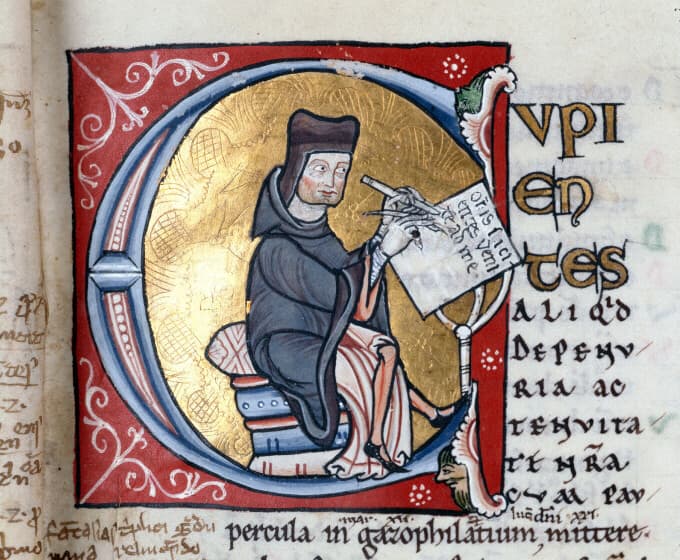
Peter Lombard
Author of the 'Sentences' — the textbook every medieval theologian had to master.
Overview
Bishop of Paris and the most influential theological teacher of the twelfth century, Peter Lombard compiled the Four Books of Sentences — a systematic ordering of Christian doctrine that arranged the conflicting opinions of the Fathers for resolution. It became the standard theology textbook of the universities for four centuries; lecturing on the Sentences was the required rite of passage for every scholastic, and Aquinas, Bonaventure, Scotus, and Ockham all wrote commentaries on it. More organizer than innovator, he gave Scholasticism its shared framework.
What they supported — and why
A systematic ordering of doctrine
SupportedArrange the whole of Christian teaching — God, creation, sin, incarnation, sacraments — into one coherent, teachable system.
WhyScattered patristic opinions needed organization so students could reason through them methodically.
Dialectical resolution of authorities
SupportedSet conflicting authoritative texts side by side and reconcile them.
WhyApparent contradictions among the Fathers, properly harmonized, yield settled doctrine.
The seven sacraments
SupportedFixed the number and nature of the sacraments as efficacious signs of grace.
WhyA clear sacramental theology was needed for consistent teaching and church practice.
Causes championed
- Systematic theology
- A shared university curriculum
- The reconciliation of authorities
Issues wrestled with
- How should Christian doctrine be organized?
- How to resolve conflicting authorities?
- What are the sacraments?
Hurdles faced
- Charges of unorthodoxy on the Trinity (later cleared)
- The labor of harmonizing centuries of texts
Works & books
1 catalogued. Status shows how much survives to today.
Four Books of Sentences
SurvivesThe standard theology textbook of the medieval universities, commented on by every major scholastic.
Read the texts free
Their works online — Open Library catalogues 81 works & editions, 6 of them free to read in full.
The influence network
See Peter Lombard in the map →Influenced by
Influenced
In their words
“The truths of faith are received on authority, then examined by reason.”
— paraphrase of his method
Legacy
His Sentences structured university theology for four hundred years, making him the framework on which the whole edifice of Scholasticism was built.
Further reading
Cross-checked against these authoritative references.