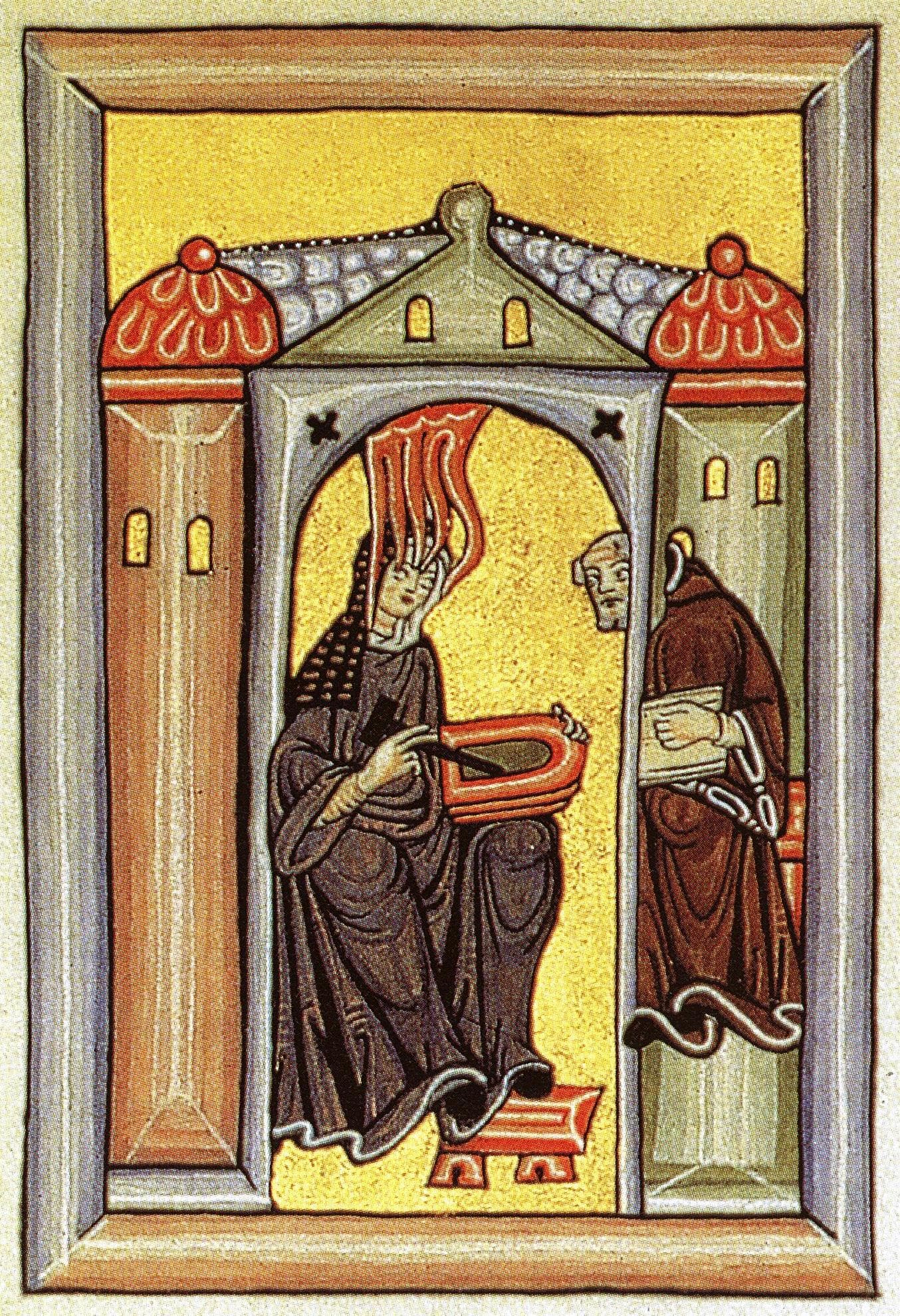
Hildegard of Bingen
Visionary abbess, composer, and natural philosopher — a rare medieval woman's voice.
Overview
A Benedictine abbess of extraordinary range, Hildegard was a visionary theologian, composer, poet, and writer on medicine and the natural world. Her illustrated visionary works — beginning with Scivias — set out a cosmic theology of the harmony between God, humanity, and creation, centered on 'viriditas', the greening life-force. Consulted by popes and emperors, she was a rare woman with public intellectual and spiritual authority in the medieval Church.
What they supported — and why
Cosmic harmony and viriditas
SupportedCreation is charged with a divine, life-giving 'greenness', and humanity is a microcosm bound to the whole cosmos.
WhyGod's vitality pervades nature, so the health of soul, body, and world are interconnected under one divine order.
Visionary knowledge
SupportedGenuine truth about God and creation can come through divinely given vision, then articulated by reason and image.
WhyShe experienced her insight as a 'living light' from God, which she set out systematically rather than merely reporting.
The unity of body, soul, and nature
SupportedPhysical medicine, morality, and spirituality form one connected order.
WhySince the human is a microcosm of creation, healing and holiness belong to a single harmonious system.
Causes championed
- The sanctity of creation
- Women's spiritual and intellectual authority
- The unity of body and soul
Issues wrestled with
- How are God, humanity, and nature related?
- Can vision yield knowledge?
- How do body and soul connect?
Hurdles faced
- Asserting authority as a woman in the medieval Church
- A late-life conflict with her ecclesiastical superiors
Works & books
3 catalogued. Status shows how much survives to today.
Scivias (Know the Ways)
SurvivesHer first and greatest visionary work, a cosmic theology in words and images.
Physica; Causae et Curae
SurvivesWorks of natural science and medicine cataloguing plants, animals, and remedies.
Ordo Virtutum and musical compositions
SurvivesA morality play and a large surviving body of luminous sacred music.
Read the texts free
Their works online — Open Library catalogues 84 works & editions.
The influence network
See Hildegard of Bingen in the map →Influenced by
Influenced
In their words
“There is a power that has been since all eternity, and that force and potentiality is green.”
— on viriditas
Legacy
One of the few medieval women whose philosophy, science, and art survive under her own name — a holistic vision of cosmos and creation.
Further reading
Cross-checked against these authoritative references.