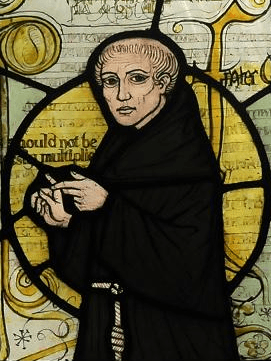
William of Ockham
Nominalist of 'Ockham's razor' who cut away universals and split faith from reason.
Overview
An English Franciscan logician, Ockham pushed Scholasticism toward nominalism and empiricism. He denied that universals exist outside the mind — only individuals are real — and wielded his 'razor': do not multiply entities beyond necessity. He sharply separated faith from reason and stressed God's absolute freedom and power. Embroiled in a bitter dispute with the papacy over Franciscan poverty, he fled to the emperor's protection and wrote influential political works defending secular power.
What they supported — and why
Nominalism
SupportedUniversals are not real things but signs or concepts; only individuals exist.
WhyThere is no need to posit shared natures or Forms to explain general terms — the mind's concepts and language suffice.
Ockham's razor (parsimony)
SupportedEntities should not be multiplied beyond necessity; prefer the simpler explanation.
WhyExplanatory economy avoids positing unneeded realities, keeping theories grounded and disciplined.
The separation of faith and reason
SupportedMany doctrines — God's existence as Christians hold it, the soul's immortality — cannot be proven by reason but are held by faith.
WhyReason's reach is limited and God's power is absolute and free, so much of theology exceeds demonstration.
Causes championed
- Logical economy
- The reality of individuals
- The freedom of God
- The limits of reason
- Secular political authority
Issues wrestled with
- Do universals exist?
- How simple should explanations be?
- What can reason prove about God?
- Who holds ultimate political power?
Hurdles faced
- Charged with heresy and summoned to Avignon
- Fled and was excommunicated in the Franciscan poverty dispute with Pope John XXII
Works & books
3 catalogued. Status shows how much survives to today.
Summa Logicae
SurvivesHis comprehensive logic, working out nominalism and the theory of signs.
Commentary on the Sentences; Quodlibetal Questions
SurvivesHis theology and metaphysics of individuals and divine power.
Political works (Dialogus; On the Power of Emperors and Popes)
SurvivesDefenses of secular authority against papal claims.
Read the texts free
Their works online — Open Library catalogues 186 works & editions, 3 of them free to read in full.
The influence network
See William of Ockham in the map →In their words
“Plurality is never to be posited without necessity.”
— the principle known as Ockham's razor
Legacy
His nominalism and his razor helped end the age of grand scholastic synthesis and pointed toward empiricism and the modern split of faith from reason.
Follow their questions
This thinker is a stop on these paths through philosophy.
Further reading
Cross-checked against these authoritative references.