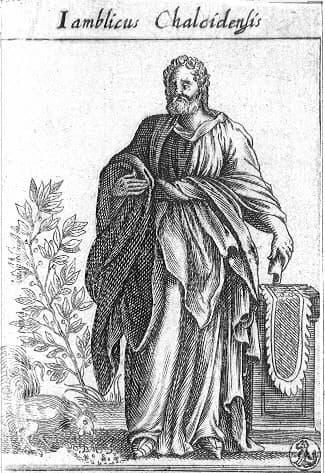
Iamblichus
Made ritual ('theurgy') central to Neoplatonism and multiplied its divine hierarchy.
Overview
A Syrian Neoplatonist and pupil of Porphyry, Iamblichus transformed the school by insisting that ritual — 'theurgy' — not philosophical contemplation alone, is needed for the soul's ascent to the divine. He greatly elaborated the metaphysical hierarchy, inserting further levels and gods between the One and the world, and wove Pythagorean number-mysticism and traditional religion into philosophy. His sacralized Neoplatonism decisively shaped Proclus and the later Athenian school.
What they supported — and why
Theurgy over contemplation
SupportedThe soul cannot reach the divine by thought alone but needs divinely instituted sacred rites.
WhyThe embodied soul has fallen so far that only sacred acts, working with the gods' own power, can lift it back.
An elaborated hierarchy
SupportedMany mediating levels and divine beings stand between the ineffable One and the material world.
WhyThe gulf between the utterly transcendent One and the world requires numerous graded intermediaries to bridge it.
Philosophy sanctifies religion
SupportedTraditional gods, myths, and Pythagorean numerology carry genuine metaphysical truth.
WhyRightly interpreted, ancestral and revealed religion aligns with the true structure of reality.
Causes championed
- The unity of religion and philosophy
- Theurgic ascent of the soul
- The revival of Pythagoreanism
Issues wrestled with
- How does the fallen soul return to the divine?
- Can ritual accomplish what reason cannot?
- How is the hierarchy of being structured?
Hurdles faced
- Defending ritual against Porphyry's more rationalist Neoplatonism
- Systematizing a vast and intricate metaphysics
Works & books
2 catalogued. Status shows how much survives to today.
On the Mysteries
SurvivesA defense of theurgy and ritual against Porphyry's objections.
On the Pythagorean Life; On General Mathematical Science
PartialPart of a large compendium reviving Pythagorean philosophy; several books survive.
Read the texts free
2 of Iamblichus’s works are free to read in full — public-domain English editions on Project Gutenberg, matched from Gutenberg’s own catalogue.
Every edition online — Open Library catalogues 131 works & editions, 12 of them free to read in full.
The influence network
See Iamblichus in the map →Influenced by
Influenced
In their words
“It is not thought that links the theurgist to the gods, but the accomplishment of sacred acts.”
— On the Mysteries (paraphrase)
Legacy
He turned Neoplatonism toward the sacred and ritual, decisively shaping Proclus and the religious philosophy of late antiquity.
Further reading
Cross-checked against these authoritative references.