Proclus
The last great pagan systematizer — Neoplatonism as rigorous, geometric metaphysics.
Overview
Head of the Platonic Academy at Athens and the most systematic of the Neoplatonists, Proclus set out the whole emanationist metaphysics in the Elements of Theology as a chain of theorems and proofs. Reality proceeds from the One through triadic cycles of 'remaining, procession, and return'. He wrote vast commentaries on Plato, integrated pagan theology and ritual (theurgy) into philosophy, and profoundly shaped medieval Christian, Islamic, and Jewish metaphysics — often at one remove, through Pseudo-Dionysius and the Liber de Causis.
What they supported — and why
Rigorous emanation
SupportedAll things proceed from the One and return to it; every effect remains in, proceeds from, and reverts to its cause.
WhyUnity must ground plurality, and a rational cosmos unfolds by necessary, demonstrable steps that can be set out like geometry.
Henads and hierarchy
SupportedBetween the One and the world stand 'henads' — divine unities — structuring the graded descent of reality.
WhyTo link the utterly simple One to the multiplicity of the world, intermediate principles are logically required.
Theurgy completes philosophy
SupportedSacred ritual and divine grace, not reasoning alone, accomplish the soul's final ascent.
WhyThe highest union exceeds discursive thought, so religious practice must cooperate with philosophy to reach it.
Causes championed
- Systematic metaphysics
- The harmony of the whole Platonic tradition
- Pagan theology in its last age
Issues wrestled with
- How does the many proceed from the One?
- How does the soul return to its source?
- Can ritual aid philosophy?
Hurdles faced
- Defending paganism as Christianity became dominant
- Sustaining the Academy in its final generations
Works & books
3 catalogued. Status shows how much survives to today.
Elements of Theology
Survives211 propositions deducing the entire Neoplatonic metaphysics in geometric form.
Platonic Theology
SurvivesA vast systematic exposition of Plato's theology.
Commentaries (Timaeus, Parmenides, Republic, Euclid)
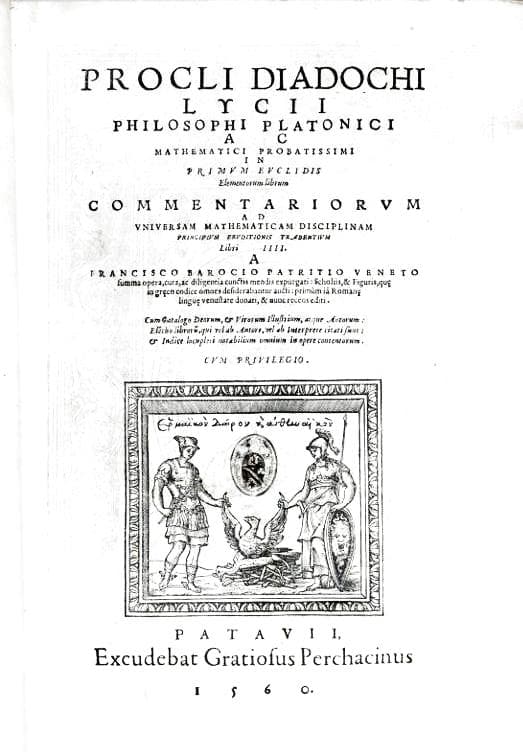
PartialExtensive commentaries on Plato and on Euclid's geometry; several survive whole or in part.
Read the texts free
3 of Proclus’s works are free to read in full — public-domain English editions on Project Gutenberg, matched from Gutenberg’s own catalogue.
Every edition online — Open Library catalogues 187 works & editions, 21 of them free to read in full.
The influence network
See Proclus in the map →Influenced by
Influenced
In their words
“Every effect remains in its cause, proceeds from it, and reverts to it.”
— Elements of Theology, Prop. 35
Legacy
He turned Neoplatonism into a rigorous system whose influence — largely through Pseudo-Dionysius and the Liber de Causis — permeated all of medieval philosophy.
Further reading
Cross-checked against these authoritative references.