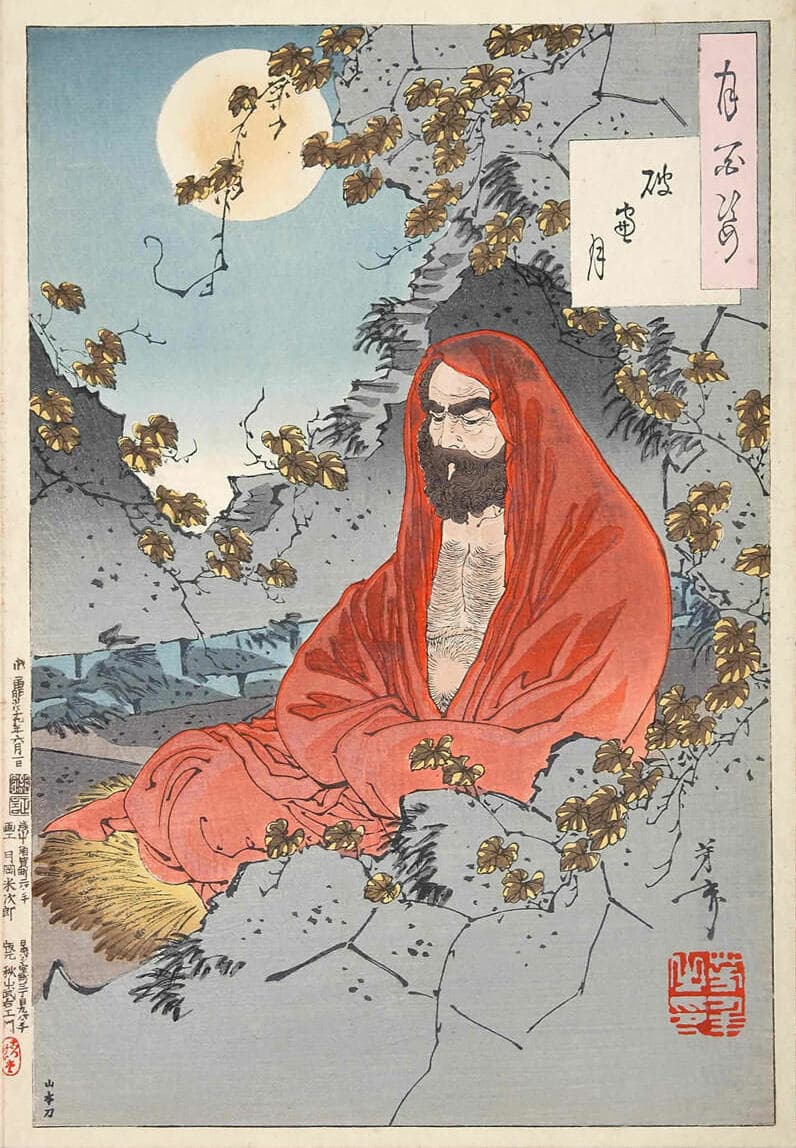
Bodhidharma
Semi-legendary first patriarch of Chan (Zen) — 'a direct pointing to the mind'.
Overview
The traditional founder of Chan (Zen) Buddhism, a monk who came from India or Central Asia to China and is honored as the first Chinese patriarch of the Chan lineage. Little reliable history survives; the earliest sources describe him only briefly, and most famous stories — nine years of wall-gazing at Shaolin, a disciple cutting off his arm, and (a purely modern myth) his founding of Shaolin kung fu — are later legend. What endures is the ideal ascribed to him: awakening by direct insight into the mind, 'not founded on words and letters.'
What they supported — and why
A special transmission outside the scriptures
SupportedAwakening passes directly from mind to mind, 'not founded on words and letters'.
WhyThe living realization of Buddhahood cannot be captured in texts and doctrines; it must be pointed to directly and awakened in experience.
Direct pointing to the mind
Supported'Point directly at the human mind; see your nature and become a Buddha.'
WhySince the Buddha-nature is one's own mind, the surest path is to turn and see it directly rather than accumulate learning.
Meditation (wall-gazing) as the way in
SupportedSustained, still contemplation quiets the discriminating mind so the original nature can appear.
WhyCalming the restless, conceptualizing mind lets its innate clarity reveal itself.
Causes championed
- Direct realization over doctrine
- Meditative insight
- The transmission of awakening
Issues wrestled with
- Can awakening be conveyed in words?
- Where is the Buddha-nature found?
- What is the role of meditation?
Hurdles faced
- Almost no reliable biography; his life is overlaid with legend
- Transmitting Indian meditative Buddhism into a new culture
Works & books
1 catalogued. Status shows how much survives to today.
(no certain writings)
AttributedShort treatises such as the 'Two Entrances and Four Practices' are attributed to him or his circle; his teaching survives mainly through the later Chan tradition.
The influence network
See Bodhidharma in the map →Influenced by
Influenced
In their words
“A special transmission outside the scriptures; pointing directly to the mind, seeing one's nature and becoming Buddha.”
— verse traditionally ascribed to Bodhidharma
Legacy
As the emblematic founder of Chan/Zen, the figure of Bodhidharma anchors one of the world's great contemplative traditions, whatever the uncertainties of his history.
Further reading
Cross-checked against these authoritative references.