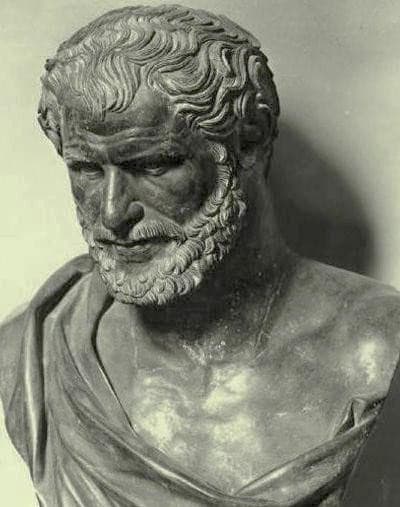
Democritus
Reality is atoms and void — a purposeless, mechanical universe.
Overview
Developing the theory of his teacher Leucippus, Democritus proposed that everything consists of atoms — indivisible, unchanging particles of infinite variety — moving in an infinite void. Sensible qualities like color and taste exist 'by convention'; only atoms and void exist 'in truth'. Worlds form and dissolve by mechanical collision, without design or purpose. Called the 'laughing philosopher', he also wrote extensively on ethics, advocating cheerfulness (euthymia) through moderation. Only ethical fragments survive of a huge output.
What they supported — and why
Atoms and void
SupportedReality consists of indivisible atoms moving in empty space; there is nothing else.
WhyTo answer Parmenides, atoms are each a tiny unchanging 'being', and the void is the 'non-being' that lets them move and combine.
Qualities are conventional
SupportedColor, sweetness, and warmth exist only in perception; in reality there are only atoms and void.
WhyDifferent atomic shapes and arrangements cause our sensations, but the qualities themselves are not in the atoms.
A universe without purpose
SupportedAll events happen by necessity through atomic motion and collision — no gods or ends required.
WhyMechanical causation among atoms suffices to explain everything, so teleology is unnecessary.
Cheerfulness (euthymia)
SupportedThe good life is a stable, cheerful state achieved through moderation and inner balance.
WhySince happiness lies in the soul's condition, not in possessions, tranquillity is the true aim.
Causes championed
- Materialist, mechanical explanation
- Ethics of contentment and moderation
Issues wrestled with
- What is matter ultimately made of?
- Are sensory qualities real?
- How should one live in a purposeless cosmos?
Hurdles faced
- Atoms and void are imperceptible — a theory ahead of any means to test it
- Nearly all his ~70 works were lost, skewing his reputation toward ethics
Works & books
3 catalogued. Status shows how much survives to today.
The Great World-System
LostMajor cosmological work (sometimes credited to Leucippus); not preserved.
The Little World-System
LostCompanion cosmological treatise; lost.
On Cheerfulness
Fragments onlyEthical work; survives as fragments urging euthymia through moderation.
Read the texts free
Their works online — Open Library catalogues 5 works & editions.
The influence network
See Democritus in the map →Influenced by
In their words
“By convention sweet, by convention bitter... in reality atoms and void.”
— Fragment (DK B9)
“Happiness resides not in possessions... happiness dwells in the soul.”
— ethical fragment
Legacy
Ancient atomism is the direct ancestor of modern physical materialism; via Epicurus and Lucretius it shaped the entire scientific worldview.
Follow their questions
This thinker is a stop on these paths through philosophy.
Further reading
Cross-checked against these authoritative references.