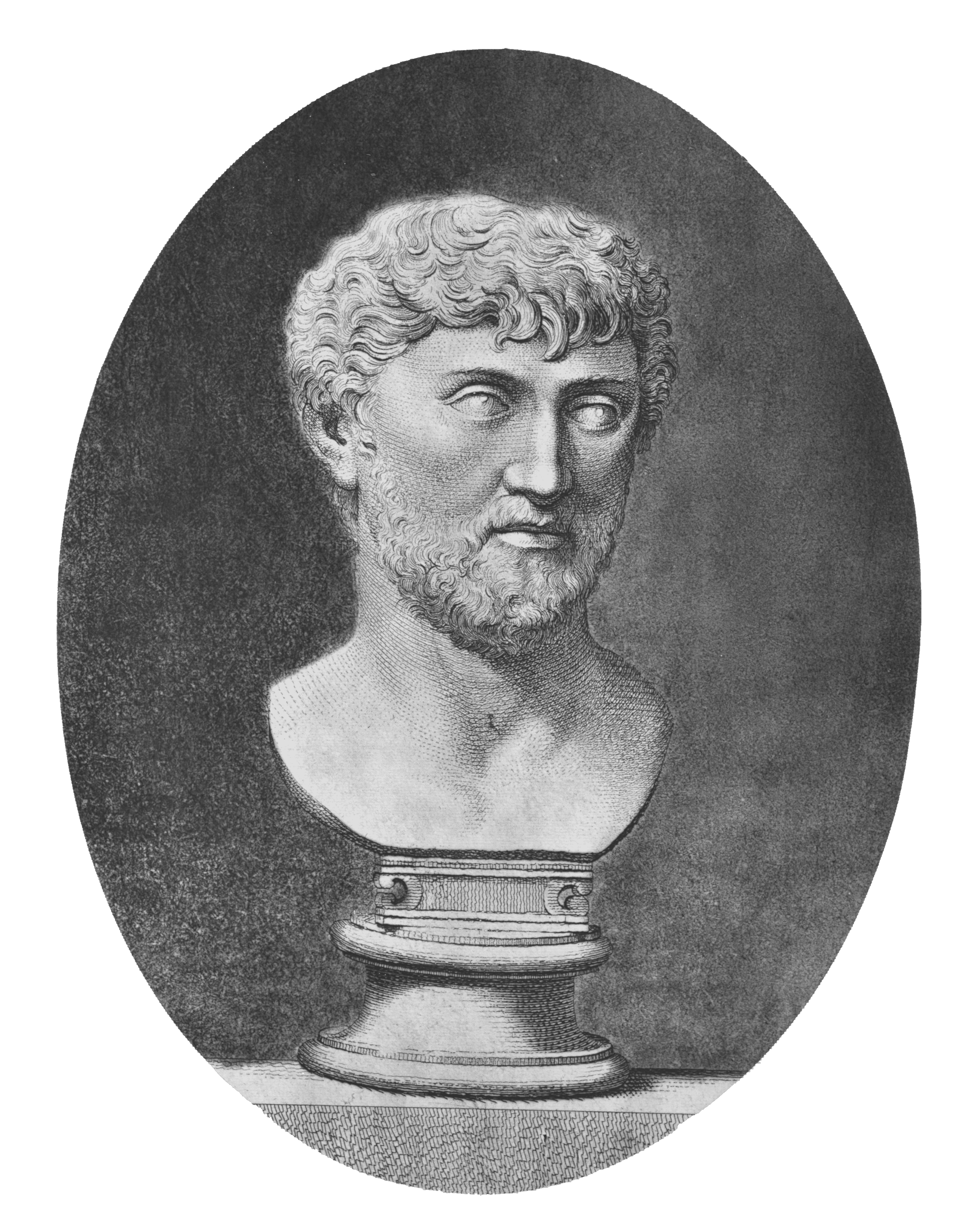
Lucretius
Titus Lucretius Carus
Cast Epicurean physics into sublime Latin verse to free humanity from fear.
Overview
A Roman poet whose single surviving work, De Rerum Natura (On the Nature of Things), expounds Epicurus' atomism and ethics in six books of majestic hexameter. He argues that everything is atoms and void, that the soul is mortal, that the gods take no interest in us, and that understanding nature dissolves the fear of death and the tyranny of superstition. Almost nothing is known of his life. His poem was nearly lost and its rediscovery in 1417 helped spark the Renaissance and modern materialism.
What they supported — and why
Atoms and void, and nothing else
SupportedAll things are temporary configurations of eternal atoms moving through empty space.
WhyNothing comes from nothing or perishes into nothing; atoms and void explain all change by mechanical combination.
The soul is mortal; death is nothing to us
SupportedMind and spirit are made of atoms and dissolve at death, ending all sensation.
WhySince the dead cannot feel anything, death can hold no terror for us — 'it is nothing to us.'
Superstition breeds misery and cruelty
SupportedFalse fear of the gods and the afterlife is a chief source of human suffering.
WhySo much evil has religion prompted; a naturalistic understanding of the world replaces dread with tranquillity.
Causes championed
- Freedom from the fear of death and the gods
- Naturalistic understanding
- Tranquillity of mind
Issues wrestled with
- What is the world ultimately made of?
- Is the soul immortal?
- Why should we not fear death?
Hurdles faced
- Rendering technical philosophy as great poetry
- An ancient (unverified) legend of madness and suicide
- The poem's near-total disappearance for a thousand years
Works & books
1 catalogued. Status shows how much survives to today.
On the Nature of Things
SurvivesA six-book Epicurean poem on atoms, the soul, perception, cosmology, and human progress — one of antiquity's masterpieces.
Read the texts free
3 of Lucretius’s works are free to read in full — public-domain English editions on Project Gutenberg, matched from Gutenberg’s own catalogue.
Every edition online — Open Library catalogues 396 works & editions, 60 of them free to read in full.
The influence network
See Lucretius in the map →Influenced by
Influenced
In their words
“So much evil has religion been able to urge.”
— De Rerum Natura, Book I
“Nothing can ever be created out of nothing.”
— De Rerum Natura, Book I
Legacy
He preserved Epicurean physics for the modern world; the 1417 rediscovery of his poem helped ignite the Renaissance and secular science.
Further reading
Cross-checked against these authoritative references.