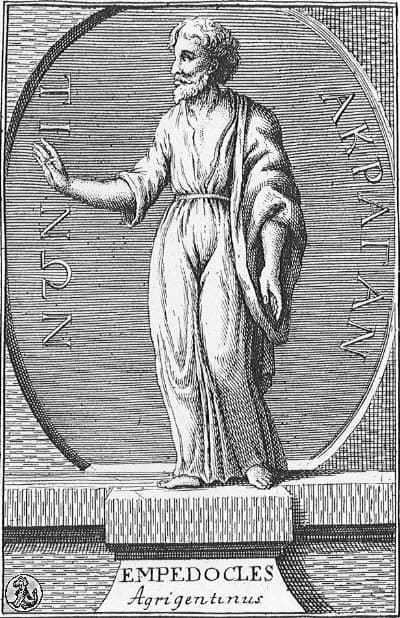
Empedocles
Four roots (earth, air, fire, water) mixed by Love and Strife.
Overview
Empedocles answered Parmenides by keeping Being eternal but making it plural. Nothing truly comes to be or perishes; there are four eternal 'roots' — earth, air, fire, water — and two cosmic forces, Love (which unites) and Strife (which separates). Their alternating dominance drives an eternal cosmic cycle. A charismatic figure who claimed near-divine status, he also proposed an early theory of evolution by the survival of viable creatures. Legend says he leapt into Mount Etna.
What they supported — and why
Four roots (elements)
SupportedAll things are mixtures of earth, air, fire, and water in fixed ratios; these never come to be or perish.
WhyThis preserves Parmenides' rule that being cannot arise from non-being, while still explaining change as mixing and separation.
Love and Strife
SupportedTwo forces alternately combine and divide the roots, driving a repeating cosmic cycle.
WhyChange needs a cause; attraction and repulsion account for how unchanging elements produce a varied, cycling world.
Proto-evolution
SupportedRandom combinations of body parts arose; only well-formed, viable creatures survived and reproduced.
WhyApparent design can emerge without a designer if unfit combinations perish.
Causes championed
- Reconciling permanence with change
- Naturalistic biology and cosmology
- Purification and reverence for life
Issues wrestled with
- How can change be real if being is eternal?
- What forces move the cosmos?
- How do organisms arise?
Hurdles faced
- Blending mysticism (Purifications) with physics (On Nature)
- Bold self-mythologizing that strained credibility
Works & books
2 catalogued. Status shows how much survives to today.
On Nature
Fragments onlyA poem expounding the four roots, Love and Strife, perception, and biology; substantial fragments survive.
Purifications
Fragments onlyA religious poem on the soul's fall, reincarnation, and purification; possibly part of the same work.
Read the texts free
Their works online — Open Library catalogues 32 works & editions, 7 of them free to read in full.
The influence network
See Empedocles in the map →Influenced by
In their words
“There is no coming-to-be of anything, nor any end in ruinous death; there is only mingling and separation of what is mingled.”
— On Nature (DK B8)
Legacy
His four elements dominated science until the 1600s, and his 'survival of the fit' anticipated evolutionary thinking by 2,300 years.
Further reading
Cross-checked against these authoritative references.