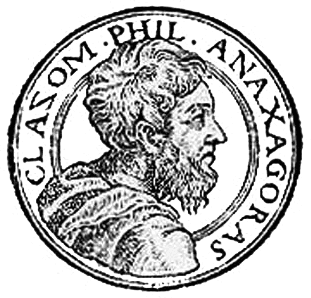
Anaxagoras
'In everything a portion of everything'; Mind (Nous) orders the cosmos.
Overview
Anaxagoras brought philosophy to Athens and taught that everything contains a portion of everything else — infinitely divisible 'seeds' of all qualities. What makes a thing what it is, is the predominance of one ingredient. Crucially, he introduced Nous (Mind) as a distinct, unmixed principle that set the primordial mixture spinning and imposed order. He explained eclipses and said the sun was a fiery stone larger than the Peloponnese — for which he was tried for impiety and forced from Athens.
What they supported — and why
Everything in everything
SupportedEvery substance contains portions of all others; nothing is purely one thing.
WhyThis lets bread turn into flesh and blood: the ingredients were already present, so nothing arises from what is wholly absent.
Nous (Mind) orders the world
SupportedMind is infinite, self-ruling, unmixed with anything, and it initiated and steers cosmic motion.
WhyOrder and life require an intelligent, separate cause distinct from the passive material mixture.
Causes championed
- Naturalistic astronomy
- Introducing intelligence as a cosmic cause
Issues wrestled with
- How can nutrition turn one substance into another?
- What set the ordered cosmos in motion?
Hurdles faced
- Prosecuted for impiety for saying the sun is a stone, not a god
- Exiled from Athens
Works & books
1 catalogued. Status shows how much survives to today.
On Nature
Fragments onlyA prose treatise on the infinite mixture, seeds, and Nous; notable fragments survive via Simplicius.
Read the texts free
Their works online — Open Library catalogues 7 works & editions, 2 of them free to read in full.
The influence network
See Anaxagoras in the map →In their words
“In everything there is a portion of everything.”
— On Nature (DK B11)
“All things were together; then Mind came and set them in order.”
— paraphrase of DK B12–13
Legacy
His Nous made mind a first principle of cosmology; Plato and Aristotle both wrestled with whether it truly explained why things are for the best.
Further reading
Cross-checked against these authoritative references.