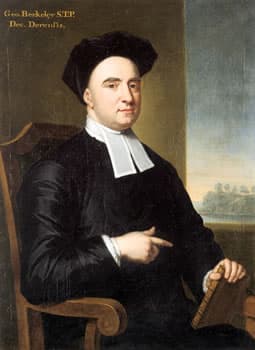
George Berkeley
Idealist empiricist — 'to be is to be perceived'; no matter, only minds and ideas.
Overview
An Irish philosopher and bishop, Berkeley pushed empiricism to a startling conclusion: there is no mind-independent matter at all. Everything we know consists of ideas (sensations), and to say a thing exists is just to say it is perceived — 'esse est percipi'. Ordinary objects are stable collections of ideas kept in existence by being continually perceived by God. He intended this 'immaterialism' to defeat the skepticism and atheism he thought materialism bred, and gave a penetrating critique of abstract ideas.
What they supported — and why
Immaterialism — 'to be is to be perceived'
SupportedThere is no material substance existing independently of minds; to exist (for sensible things) is to be perceived.
WhyWe only ever experience ideas/sensations, never a 'matter' behind them, and the very notion of an unperceived, mind-independent object is incoherent.
Objects as ideas sustained by God
SupportedPhysical objects are orderly collections of ideas; their continued existence when no human perceives them is secured by their being perceived by God.
WhyIdeas exist only in minds, so the constancy and order of nature require an infinite mind — God — perpetually perceiving and willing them.
Against abstract ideas
SupportedThere are no genuinely abstract general ideas (like 'triangle in general' with no particular features); generality is a use of particular ideas.
WhyOne cannot actually form an idea stripped of all specific qualities, so abstractionism rests on a confusion that breeds error.
Causes championed
- Defeating materialism, skepticism, and atheism
- A world grounded in mind and God
- Clarity against abstraction
Issues wrestled with
- Does matter exist independently of mind?
- What makes objects persist unperceived?
- Are there abstract ideas?
Hurdles faced
- The intuitive strangeness of denying matter (Dr. Johnson 'refuted' him by kicking a stone)
- A failed project to found a college in Bermuda
Works & books
2 catalogued. Status shows how much survives to today.
A Treatise Concerning the Principles of Human Knowledge
SurvivesHis systematic case for immaterialism.
Three Dialogues between Hylas and Philonous
SurvivesA vivid dialogue defending 'to be is to be perceived'.
Read the texts free
6 of George Berkeley’s works are free to read in full — public-domain English editions on Project Gutenberg, matched from Gutenberg’s own catalogue.
Every edition online — Open Library catalogues 294 works & editions, 66 of them free to read in full.
The influence network
See George Berkeley in the map →In their words
“To be is to be perceived (esse est percipi).”
— Principles of Human Knowledge
Legacy
His immaterialism is a landmark of empiricism and idealism alike, and his critique of abstraction and matter still sharpens debates in metaphysics.
Follow their questions
This thinker is a stop on these paths through philosophy.
Further reading
Cross-checked against these authoritative references.