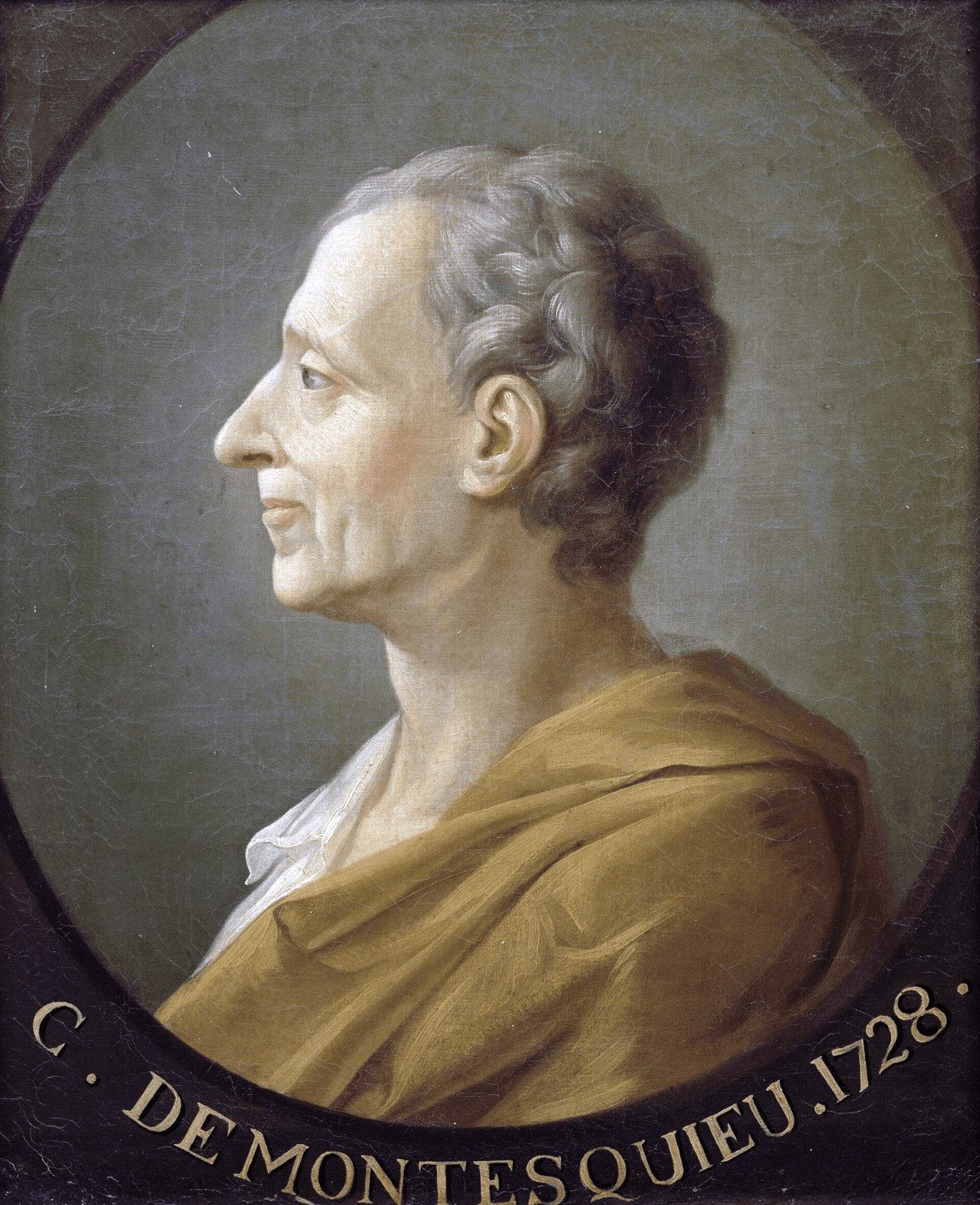
Montesquieu
Charles-Louis de Secondat, Baron de Montesquieu
Theorist of the separation of powers and the spirit of the laws.
Overview
A French Enlightenment thinker whose Spirit of the Laws founded the comparative, sociological study of political systems. He argued that laws must fit the character, climate, customs, and circumstances of a people, and classified governments by their animating principles. Most influentially, he analyzed political liberty as requiring the separation of legislative, executive, and judicial powers so that power checks power — a doctrine that directly shaped the United States Constitution and modern constitutionalism.
What they supported — and why
Separation of powers
SupportedLiberty is preserved when legislative, executive, and judicial powers are held by distinct bodies that check one another.
Why'Power should be a check to power'; concentrating powers in one hand leads to tyranny, so dividing them safeguards freedom.
Laws suited to a people (the 'spirit' of laws)
SupportedGood laws depend on a nation's climate, geography, customs, economy, and form of government — there is no single ideal code for all.
WhySince peoples differ in their conditions and character, laws must be relative to them to work, making political science comparative and empirical.
Governments by their principles
SupportedRepublics run on virtue, monarchies on honor, and despotisms on fear.
WhyEach form of government is sustained by a distinctive animating passion, and understanding it explains how regimes flourish or decay.
Causes championed
- Political liberty
- Constitutional checks on power
- A comparative science of law and society
Issues wrestled with
- How is liberty secured against tyranny?
- Why do laws differ across societies?
- What sustains each kind of government?
Hurdles faced
- Censorship — his works were placed on the Index
- Writing critically of absolutism under an absolute monarchy
Works & books
2 catalogued. Status shows how much survives to today.
The Spirit of the Laws
SurvivesHis comparative analysis of government, law, and liberty.
Persian Letters
SurvivesA witty satirical novel critiquing European society through foreign eyes.
Read the texts free
Their works online — Open Library catalogues 603 works & editions, 66 of them free to read in full.
The influence network
See Montesquieu in the map →Influenced by
Influenced
In their words
“Power should be a check to power.”
— The Spirit of the Laws
Legacy
His separation of powers is built into modern constitutions worldwide, and his comparative method helped found political and social science.
Further reading
Cross-checked against these authoritative references.