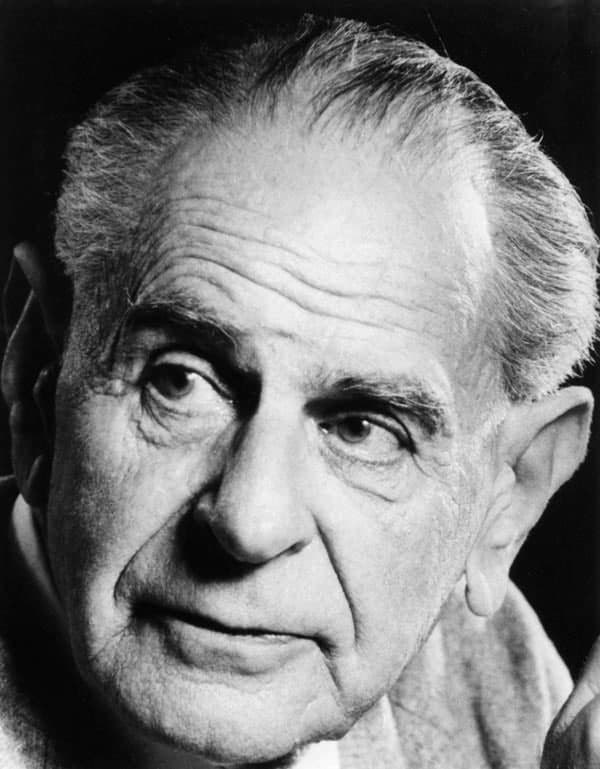
Karl Popper
Philosopher of science and the open society — knowledge grows by refutation.
Overview
An Austrian-British philosopher who reshaped the philosophy of science and defended liberal democracy. Against the idea that science proves theories by piling up confirmations, Popper argued that science advances by bold conjectures that we then try to refute: what makes a theory scientific is that it is falsifiable. In politics, his 'open society' champions piecemeal reform, criticism, and freedom against the closed, utopian certainties he traced to historicism.
What they supported — and why
Falsifiability as the mark of science
SupportedA theory is scientific only if it forbids something — if it can in principle be refuted by observation; unfalsifiable theories are not scientific.
WhyConfirmations are easy to find for almost any theory; genuine science sticks its neck out and risks refutation, which is what gives it empirical content.
Conjectures and refutations
SupportedKnowledge grows not by proof but by proposing bold hypotheses and rigorously trying to falsify them, retaining those that survive.
WhyWe can never verify a universal law by finite evidence, but a single counter-instance can refute it, so criticism, not accumulation, drives progress.
The open society
SupportedA free society welcomes criticism and reforms itself piecemeal; closed, utopian schemes claiming to know history's laws breed tyranny.
WhySince our knowledge is fallible, politics too should be experimental and open to correction, not imposed by those who claim certain knowledge of the future.
Causes championed
- A rigorous, self-critical science
- Fallibilism
- The open, liberal society against totalitarianism
Issues wrestled with
- What distinguishes science from pseudoscience?
- How does knowledge grow?
- What kind of society safeguards freedom?
Hurdles faced
- Fleeing Nazism into exile
- Sharp disputes with logical positivists and, later, with Kuhn
Works & books
2 catalogued. Status shows how much survives to today.
The Logic of Scientific Discovery
SurvivesHis theory of falsifiability and scientific method.
The Open Society and Its Enemies
SurvivesHis defense of liberal democracy and critique of Plato, Hegel, and Marx.
Read the texts free
Their works online — Open Library catalogues 93 works & editions.
The influence network
See Karl Popper in the map →In their words
“A theory that explains everything explains nothing.”
— paraphrase of Popper
Legacy
He made falsifiability central to how we understand science and gave liberal democracy a powerful philosophical defense.
Follow their questions
This thinker is a stop on these paths through philosophy.
Further reading
Cross-checked against these authoritative references.