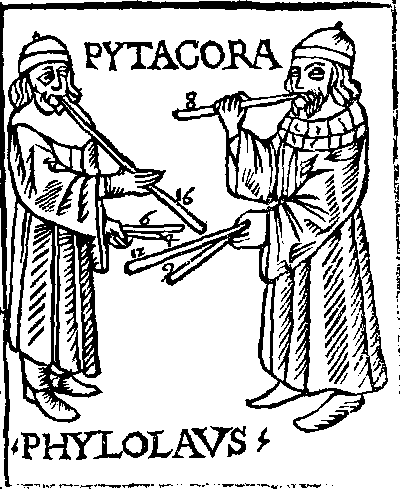
Philolaus
First Pythagorean to publish; put a 'central fire', not the earth, at the cosmos's heart.
Overview
The first Pythagorean known to have written a book, Philolaus made the secretive school's doctrine public. He held that all things are known through number and are composed of 'limiters' and 'unlimiteds' fitted together by harmony. His astronomy was radical: he removed the earth from the center of the cosmos and set it revolving around a 'central fire' — a step away from geocentrism that centuries later helped inspire Copernicus.
What they supported — and why
Limiters and unlimiteds in harmony
SupportedAll things arise from limiting and unlimited principles brought together by harmony.
WhyNature everywhere shows bounded forms imposed on boundless material, and it is number and harmony that make them knowable.
Knowledge through number
SupportedThings can be known only insofar as they possess number.
WhyNumber gives definiteness; without it nothing could be distinguished, grasped, or understood.
The central fire (a non-geocentric cosmos)
SupportedThe earth is not the center but revolves, with the other bodies, around a central fire.
WhyTo give the cosmos a divine center of order and to explain the heavens' motions, he displaced the earth from the middle.
Causes championed
- Making Pythagorean wisdom public
- A mathematical cosmology
- Harmony as a cosmic principle
Issues wrestled with
- What makes things knowable?
- What is the structure of the cosmos?
- Is the earth the center of things?
Hurdles faced
- Breaking the Pythagorean vow of secrecy
- A cosmology far ahead of common sense
Works & books
1 catalogued. Status shows how much survives to today.
On Nature
Fragments onlyThe first written Pythagorean book, on number, harmony, and the cosmos; survives in fragments (some disputed).
Read the texts free
Their works online — Open Library catalogues 4 works & editions, 1 of them free to read in full.
The influence network
See Philolaus in the map →Influenced by
Influenced
In their words
“All things that are known have number; for it is not possible for anything to be thought of or known without this.”
— Fragment (DK B4)
Legacy
He brought Pythagoreanism into the open and offered the first non-geocentric cosmos — a seed that reached Copernicus two thousand years later.
Further reading
Cross-checked against these authoritative references.