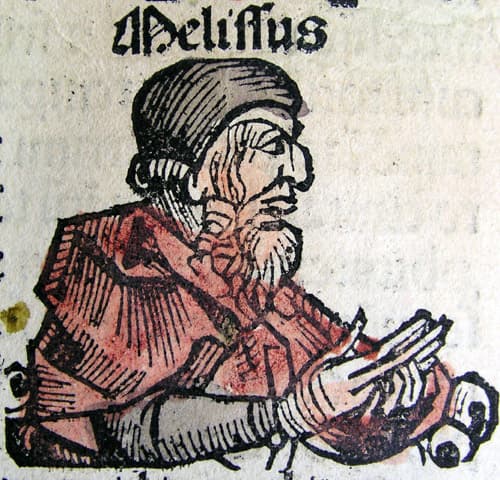
Melissus of Samos
Eleatic who argued Being is infinite — and an admiral who beat the Athenian fleet.
Overview
The last major Eleatic, Melissus was also a Samian statesman and naval commander who defeated an Athenian fleet around 441/440 BCE. He restated Parmenides' monism in clear prose and pressed it further: what-is is ungenerated, eternal, and unlimited — infinite in extent as well as in time, contrary to Parmenides' finite sphere. From its unity and changelessness he argued there can be no void, no motion, and no real plurality.
What they supported — and why
Being is one and infinite
SupportedWhat exists is ungenerated, eternal, unlimited in magnitude and duration, single and uniform.
WhyIf it came to be, it came from nothing (impossible); with nothing outside to bound it and no beginning or end in time, it must be unlimited.
No void, no motion
SupportedThere is no empty space and hence no real motion or rearrangement.
WhyMotion would require void — a kind of not-being — which cannot exist; so change is only apparent.
Causes championed
- Rigorous Eleatic monism
- Argument by drawing out consequences
Issues wrestled with
- Is Being finite or infinite?
- Can empty space exist?
- Is change real?
Hurdles faced
- Reconciling strict monism with the obviously plural world
- His arguments became a favorite target for Aristotle's criticism
Works & books
1 catalogued. Status shows how much survives to today.
On Nature (or On What-Is)
Fragments onlyA prose treatise systematizing Eleatic monism; substantial fragments survive via Simplicius.
Read the texts free
Their works online — Open Library catalogues 3 works & editions.
The influence network
See Melissus of Samos in the map →Influenced by
Influenced
In their words
“If it is, it must be one; and being one, it must have no body.”
— paraphrase of the fragments
Legacy
He gave Eleatic monism its fullest prose statement and, by denying the void, forced the atomists to defend empty space as the ground of all motion.
Further reading
Cross-checked against these authoritative references.