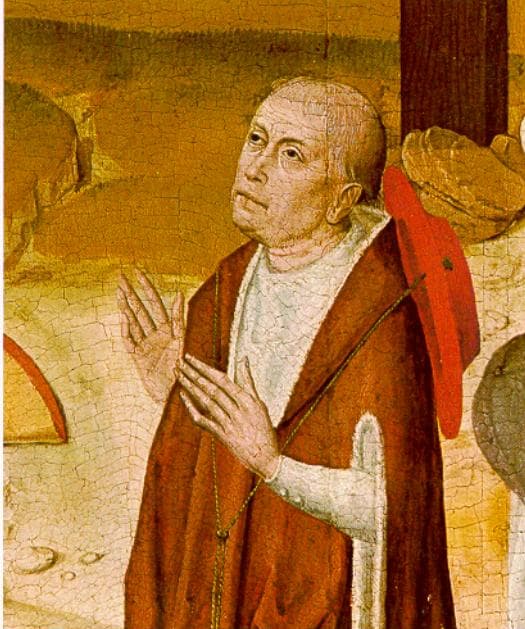
Nicholas of Cusa
Nicolaus Cusanus
'Learned ignorance' and the coincidence of opposites — a bridge from medieval to modern.
Overview
A German cardinal, philosopher, and polymath who stands at the threshold between the medieval and modern worlds. In De Docta Ignorantia ('On Learned Ignorance') he argued that the finite mind cannot comprehend the infinite God, but can knowingly embrace its own ignorance and approach truth through the 'coincidence of opposites' — the idea that in the infinite, all contradictions converge. Anticipating modern cosmology, he held that the universe has no fixed center and the earth is not at rest. Steeped in Neoplatonism and negative theology, he influenced Bruno, Copernicus, and Leibniz; Ernst Cassirer called him the 'first modern thinker'.
What they supported — and why
Learned ignorance (docta ignorantia)
SupportedThe finite mind cannot fully grasp the infinite; the highest wisdom is to know, precisely and rigorously, the limits of our knowing.
WhyGod is infinite and beyond all measure, so genuine wisdom is not a false claim to comprehend the divine but a knowing awareness of our own limits that paradoxically draws nearer to truth.
The coincidence of opposites (coincidentia oppositorum)
SupportedIn the infinite (God), opposites that contradict one another in finite things — maximum and minimum, center and circumference — coincide.
WhyDistinctions and contraries belong to the finite, measured world; in the truly infinite they collapse into a single unity beyond the reach of ordinary logic.
A universe with no fixed center
SupportedThe universe has no absolute center and no outermost circumference; the earth is a moving star, not the still center of all.
WhyIf only God is the true center and boundary of an unbounded universe, then no physical place is privileged — a striking anticipation of modern cosmology.
Causes championed
- The knowability and unknowability of God
- The reconciliation of opposites in unity
- A new, open cosmology
Issues wrestled with
- Can the infinite God be known?
- How do opposites relate in the infinite?
- Is the earth the center of the universe?
Hurdles faced
- Reconciling bold speculation with his role as a cardinal (though he was never charged with heresy)
- Conflicts over church reform and his diocese
Works & books
2 catalogued. Status shows how much survives to today.
On Learned Ignorance
SurvivesHis central work on the limits of knowledge, the coincidence of opposites, and the infinite universe.
On Conjectures; The Vision of God
SurvivesFurther works on knowledge, mind, and the mystical approach to God.
Read the texts free
Their works online — Open Library catalogues 207 works & editions, 3 of them free to read in full.
The influence network
See Nicholas of Cusa in the map →Influenced by
Influenced
In their words
“The intellect approaches truth as a polygon approaches a circle — ever closer, yet never coinciding.”
— paraphrase of De Docta Ignorantia
Legacy
A hinge between medieval and modern thought: his learned ignorance, coincidence of opposites, and centerless universe reached forward to Bruno, Copernicus, and modern philosophy.
Further reading
Cross-checked against these authoritative references.