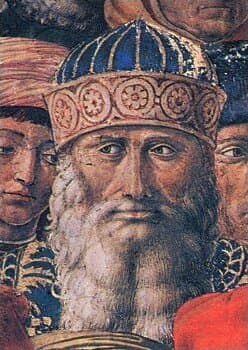
Gemistos Plethon
George Gemistos Plethon
Last of the Byzantine Platonists who reignited Plato in the Renaissance West.
Overview
A Byzantine Neoplatonist of the empire's final years, George Gemistos — who took the name 'Plethon' to echo Plato — was a radical Platonist who exalted Plato over Aristotle and even dreamed of reviving a reformed Neoplatonic paganism. Attending the Council of Florence (1438–39), he electrified Italian humanists with his lectures on Plato. He is traditionally credited with inspiring Cosimo de' Medici to found the Platonic Academy (a direct link modern scholars such as James Hankins question), and his lectures undoubtedly helped ignite the Renaissance rediscovery of Plato.
What they supported — and why
The supremacy of Plato over Aristotle
SupportedPlato's philosophy, read through Neoplatonism, is truer and higher than Aristotle's.
WhyPlato grasps the eternal Forms and the divine order more deeply than Aristotle's more earthbound system.
A Neoplatonic religious vision
SupportedReality is an eternal, providentially ordered cosmos flowing from a supreme God, best expressed in a Platonic theology.
WhyHe believed a rationally ordered Platonic religion could renew a decaying civilization.
Platonic political reform
SupportedHe proposed sweeping reforms for the dying Byzantine state along Platonic lines.
WhyA well-ordered polity, like Plato's, should rest on reason, virtue, and a rational religion.
Causes championed
- The revival of Plato
- A Platonic reform of religion and society
- The transmission of Greek philosophy to the West
Issues wrestled with
- Is Plato or Aristotle the greater philosopher?
- What is the best religion and polity?
- How can a dying civilization be saved?
Hurdles faced
- The collapse of the Byzantine Empire around him
- His radical crypto-pagan Book of Laws was burned after his death by the Orthodox patriarch
Works & books
2 catalogued. Status shows how much survives to today.
On the Differences of Aristotle from Plato
SurvivesThe lectures that reawakened Renaissance Italy's interest in Plato.
Nomoi (Book of Laws)
Fragments onlyHis radical Platonic-pagan vision, largely burned; survives only in fragments.
Read the texts free
Their works online — Open Library catalogues 4 works & editions.
The influence network
See Gemistos Plethon in the map →In their words
“Plato comes far nearer than Aristotle to the truth about divine things.”
— On the Differences of Aristotle from Plato (paraphrase)
Legacy
The last Byzantine Platonist, he carried the living flame of Plato to Renaissance Italy, seeding the rebirth of Platonism in the West.
Further reading
Cross-checked against these authoritative references.