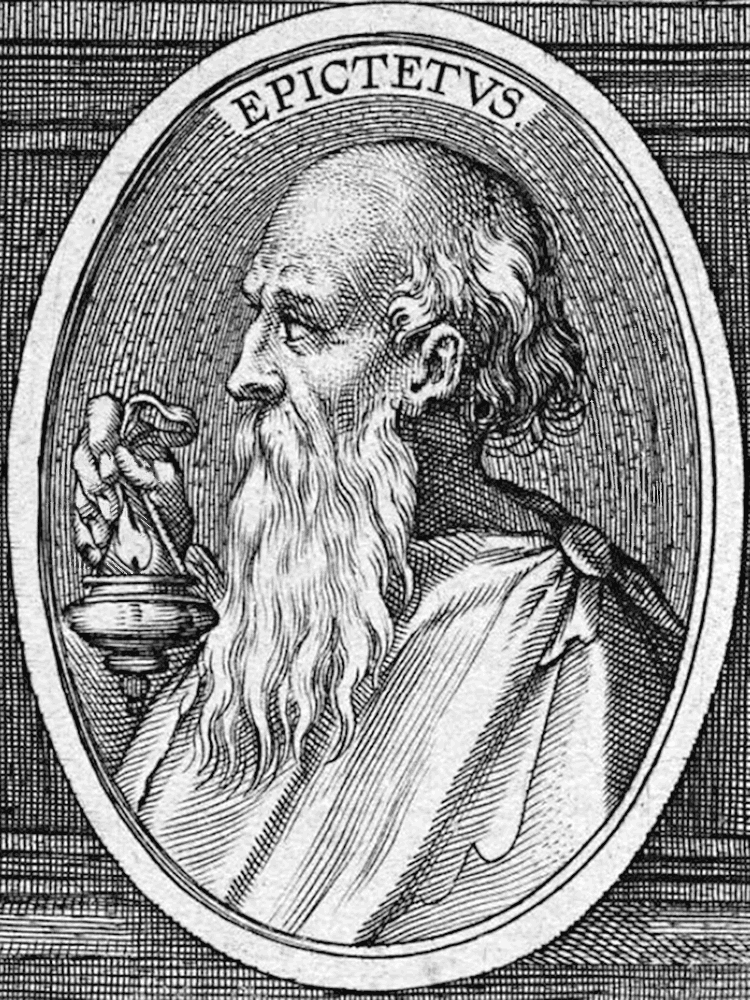
Epictetus
Born a slave; taught that freedom lies in what is 'up to us'.
Overview
Born into slavery in the Roman Empire and lamed by mistreatment, Epictetus gained his freedom and became one of the most influential Stoic teachers. Banished from Rome, he founded a school in Nicopolis. He wrote nothing; his pupil Arrian recorded his lessons as the Discourses and the Enchiridion (Handbook). His core teaching is the 'dichotomy of control': some things are up to us (our judgements, desires, actions) and some are not (body, property, reputation, others' deeds). Peace and freedom come from caring only about the former.
What they supported — and why
The dichotomy of control
SupportedDistinguish what is up to us (our own choices and judgements) from what is not (everything external), and invest only in the former.
WhyWe suffer when we stake our wellbeing on what we cannot control; focusing on our own will makes happiness invulnerable.
It is judgements that disturb us
SupportedEvents do not upset people; their opinions about events do.
WhyThe same event leaves one person calm and another distraught, so the disturbance lies in the judgement, which we can revise.
Play your role well
SupportedAccept the part life assigns and perform it with virtue, as an actor plays a role.
WhyWe choose neither our circumstances nor lifespan, only how well we act within them — and that is where virtue lives.
Causes championed
- Inner freedom independent of status
- Moral self-discipline
- Human dignity even in slavery
Issues wrestled with
- What is genuinely in our power?
- How do we achieve tranquillity?
- What is true freedom?
Hurdles faced
- Born a slave and physically lamed
- Exiled from Rome when Domitian banished philosophers
Works & books
2 catalogued. Status shows how much survives to today.
Discourses
PartialFour of eight books survive, recorded by his student Arrian — vivid lessons on living Stoically.
Enchiridion (Handbook)
SurvivesA concise manual of Stoic practice distilled from the Discourses; hugely influential across the centuries.
Read the texts free
4 of Epictetus’s works are free to read in full — public-domain English editions on Project Gutenberg, matched from Gutenberg’s own catalogue.
Every edition online — Open Library catalogues 540 works & editions, 67 of them free to read in full.
The influence network
See Epictetus in the map →Influenced by
Influenced
In their words
“It is not things that disturb us, but our judgements about things.”
— Enchiridion
“Some things are within our power, while others are not.”
— Enchiridion, opening line
Legacy
His dichotomy of control is the most practically influential idea in Stoicism and a direct ancestor of cognitive behavioral therapy.
Follow their questions
This thinker is a stop on these paths through philosophy.
Further reading
Cross-checked against these authoritative references.