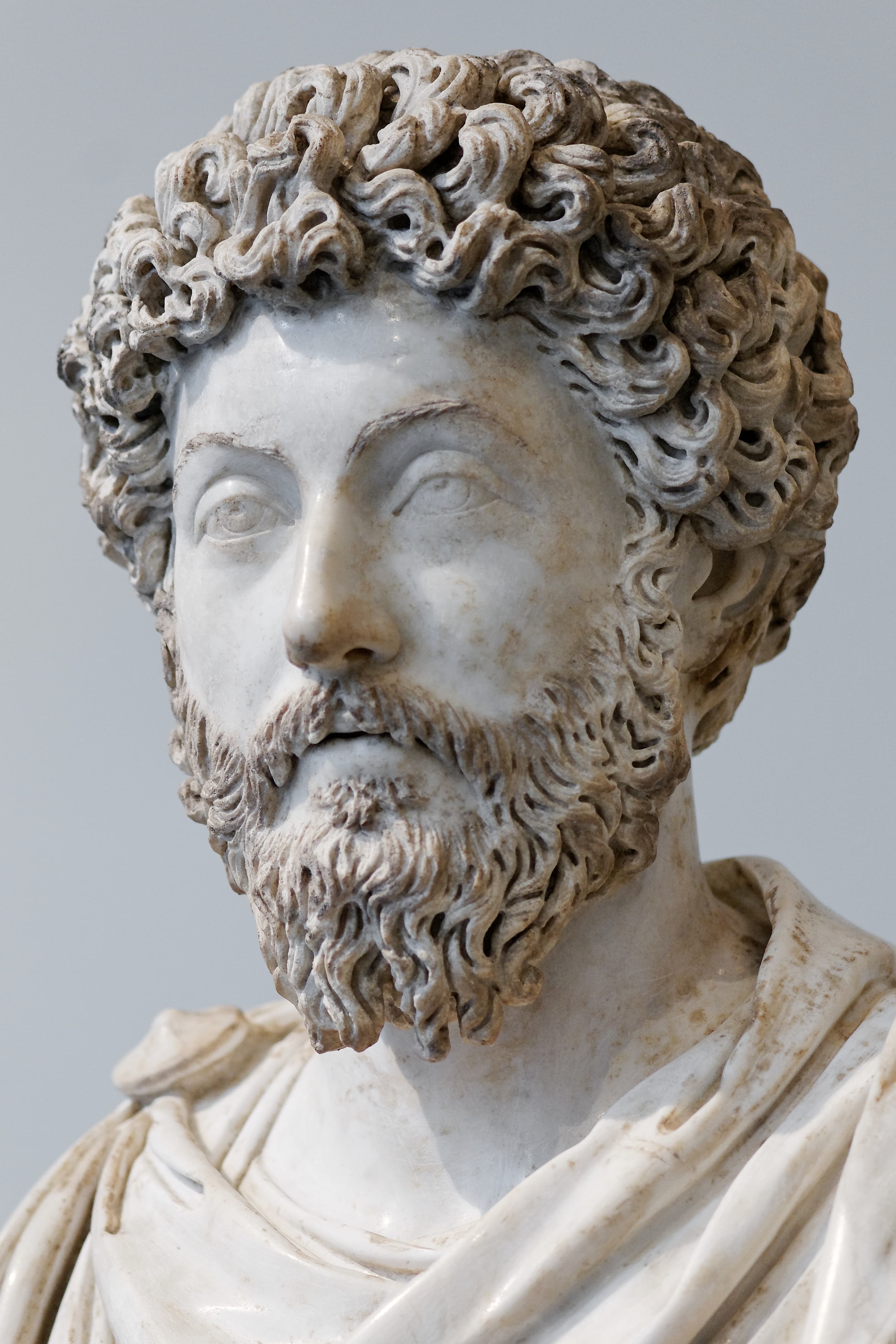
Marcus Aurelius
Roman emperor and Stoic who wrote the Meditations to himself.
Overview
Ruler of the Roman Empire at its height and the last of the 'Five Good Emperors', Marcus Aurelius practiced Stoicism amid war, plague, and the burdens of power. His private notebook, later titled the Meditations, was never meant for publication — it is a series of reminders to himself to act justly, accept fate, master his reactions, and remember the brevity of life. It stands as a rare record of a powerful man striving daily to be good, and remains one of the most beloved works of practical philosophy.
What they supported — and why
Master your own mind
SupportedOur life is what our thoughts make it; guard the ruling faculty and judge impressions rightly.
WhyExternal things cannot touch the soul; disturbance comes from within, so the inner citadel is where freedom is won.
Accept nature and fate (amor fati)
SupportedWelcome whatever the cosmic order brings, as a part cooperating with the whole.
WhyThe universe is a rational, interconnected system; resisting what happens is both futile and a kind of ingratitude.
Live for the common good
SupportedWe are made for cooperation; act justly toward others as limbs of one body.
WhyRational beings share one reason and one community, so serving the common good is acting according to our nature.
Remember mortality (memento mori)
SupportedKeep death and the transience of all things constantly in view.
WhyAwareness of life's brevity strips away vanity and fixes attention on living virtuously now.
Causes championed
- Duty and just governance
- Self-mastery amid power
- Universal human kinship
Issues wrestled with
- How to remain good while wielding absolute power?
- How to accept suffering, loss, and death?
- What do we owe one another?
Hurdles faced
- Ruled through the Antonine Plague and constant frontier wars
- Betrayed by a usurping general (Avidius Cassius); grief over many dead children
Works & books
1 catalogued. Status shows how much survives to today.
Meditations
SurvivesTwelve books of private Stoic reflections written on campaign; never intended for publication yet a timeless classic of self-guidance.
Read the texts free
4 of Marcus Aurelius’s works are free to read in full — public-domain English editions on Project Gutenberg, matched from Gutenberg’s own catalogue.
Every edition online — Open Library catalogues 504 works & editions, 41 of them free to read in full.
The influence network
See Marcus Aurelius in the map →Influenced by
Influenced
In their words
“You have power over your mind — not outside events. Realize this, and you will find strength.”
— Meditations
“The happiness of your life depends upon the quality of your thoughts.”
— attributed to the Meditations
Legacy
The Meditations is perhaps the most widely read work of ancient philosophy today — proof that Stoicism is a practice, not just a doctrine.
Follow their questions
This thinker is a stop on these paths through philosophy.
Further reading
Cross-checked against these authoritative references.