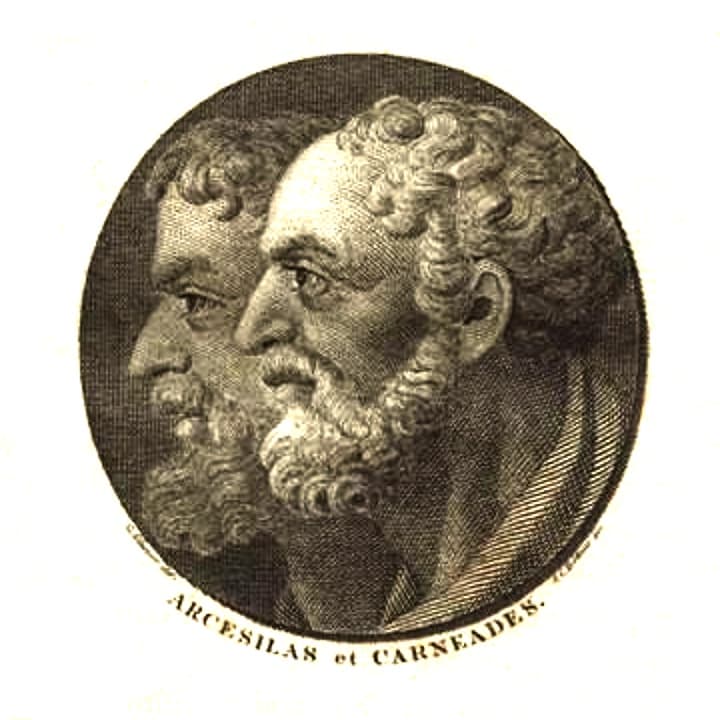
Arcesilaus
Turned Plato's Academy skeptical — suspend judgement, act on the reasonable.
Overview
As head of Plato's Academy, Arcesilaus redirected it toward skepticism, reviving Socratic questioning against the confident dogmatism of the Stoics. He attacked the Stoic 'apprehensive impression' — their proposed criterion of certain truth — and argued that for every impression an indistinguishable false one is possible. Asserting nothing himself, he argued both sides of every question and recommended suspension of judgement (epochē), offering 'the reasonable' as a practical guide to action.
What they supported — and why
Nothing can be known with certainty
SupportedNo impression carries a guarantee of its own truth, so the Stoic criterion of knowledge fails.
WhyFor any supposedly 'apprehensive' impression, an equally compelling false one can be constructed, so certainty is unattainable.
Suspend judgement; act on the reasonable
SupportedWithhold assent to all dogmatic claims, and in daily life follow what is reasonable (to eulogon).
WhySince certainty is unavailable, refusing dogmatic assent avoids error, while 'the reasonable' still allows one to act.
Causes championed
- Socratic questioning
- Anti-dogmatism
- Intellectual humility
Issues wrestled with
- Is there a criterion of truth?
- Can a skeptic act without beliefs?
Hurdles faced
- The 'inaction' objection — that skepticism makes life impossible
- Leaving no writings, risking misrepresentation
Works & books
1 catalogued. Status shows how much survives to today.
(none — wrote nothing)
LostLike Socrates, he wrote nothing; his views survive through Cicero, Sextus Empiricus, and Diogenes Laërtius.
The influence network
See Arcesilaus in the map →In their words
“He used to suspend judgement upon all matters.”
— Diogenes Laërtius
Legacy
He launched nearly three centuries of Academic skepticism and its great contest with Stoicism over whether knowledge is possible.
Further reading
Cross-checked against these authoritative references.