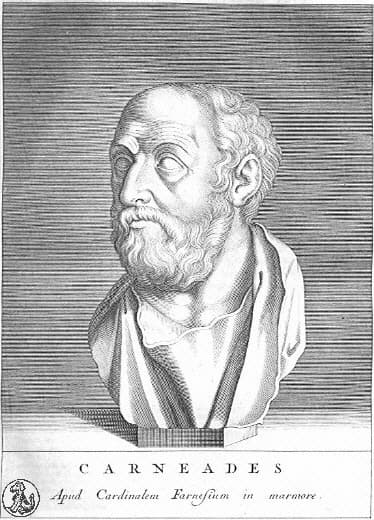
Carneades
The Academy's greatest skeptic — argued for and against justice on successive days.
Overview
A dazzling head of the New Academy, Carneades perfected Academic skepticism against the Stoics. On a famous embassy to Rome in 155 BCE he argued powerfully for justice one day and against it the next, scandalizing Cato, who had him expelled. He denied any criterion of certain truth yet, to answer the charge that skeptics cannot live, developed a theory of the 'persuasive' or probable (to pithanon): graded degrees of credibility that guide belief and action without claiming certainty.
What they supported — and why
No criterion of truth
SupportedNeither the senses nor reason yields certainty; the Stoic 'apprehensive impression' cannot be trusted.
WhyFalse impressions can be perfectly indistinguishable from true ones, so nothing guarantees which are true.
Probabilism
SupportedAct on impressions that are persuasive, corroborated, and undisturbed — a scale of credibility, not certainty.
WhyLife requires a guide; the tested, plausible impression is rationally usable even though it is not certain.
Critique of theology and fate
SupportedHe marshaled formidable arguments against Stoic proofs of the gods and against determinism.
WhyExposing the weakness of dogmatic arguments on both sides enforces suspension of judgement.
Causes championed
- Dialectical scrutiny of all dogma
- A livable skepticism
- Freedom from determinism
Issues wrestled with
- Is certainty possible?
- How can we act without it?
- Do the gods exist, and are we fated?
Hurdles faced
- The charge that arguing both sides is mere sophistry
- Writing nothing himself, he depended on students to record him
Works & books
1 catalogued. Status shows how much survives to today.
(none — wrote nothing)
LostHis arguments were preserved by his pupil Clitomachus and reported by Cicero (Academica) and Sextus Empiricus.
The influence network
See Carneades in the map →Influenced by
Influenced
In their words
“Nothing can be grasped for certain — not even that nothing can be grasped.”
— skeptical formula of the Academy
Legacy
The high-water mark of ancient skepticism; his theory of the probable prefigures modern accounts of rational, graded belief.
Further reading
Cross-checked against these authoritative references.