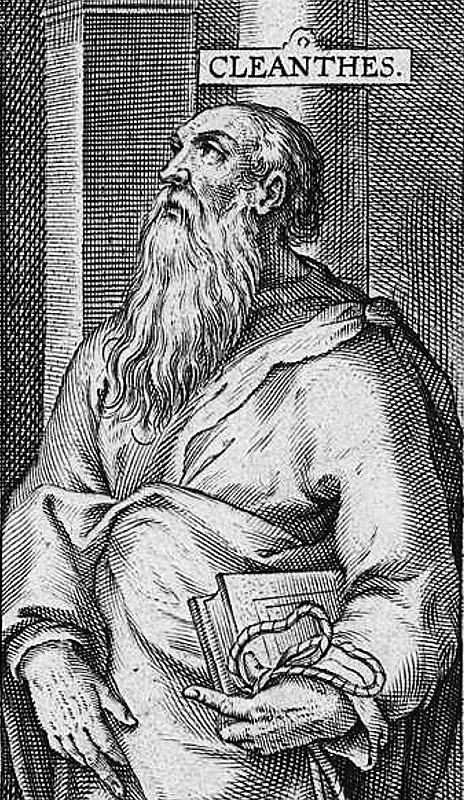
Cleanthes
The boxer-turned-Stoic who drew water by night and led the Stoa.
Overview
A former boxer of humble means, Cleanthes funded his philosophical studies by drawing water and grinding grain at night, then succeeded Zeno as head of the Stoa for over thirty years. He deepened Stoic physics and theology; his Hymn to Zeus — the fullest surviving Stoic religious text — praises the rational, providential god (Zeus/Logos) who governs all by law. Mocked as slow, he outlasted his critics and, refusing food during an illness, died at about ninety-nine.
What they supported — and why
Live in agreement with Nature
SupportedThe goal of life is accord with cosmic Nature — that is, with Zeus and the rational law that pervades all.
WhyThe cosmos is a providential, rational whole, so virtue is the willing alignment of our lives with its order.
Cosmic theology
SupportedGod, fire, reason, providence, and fate are one divine principle indwelling and steering the whole cosmos.
WhyThe life and order of the universe imply a single rational, divine force at work within it.
Causes championed
- Piety toward the rational cosmos
- Disciplined self-support
- Endurance and steadfastness
Issues wrestled with
- How does divine reason govern nature?
- What does it mean to live 'according to nature'?
Hurdles faced
- Extreme poverty — he worked manual jobs while studying
- Ridiculed as dull-witted, he had to prove himself over decades
Works & books
2 catalogued. Status shows how much survives to today.
Hymn to Zeus
SurvivesThe great surviving Stoic hymn, praising the providential rule of Zeus/Logos over all things.
On the Gods; physical and ethical treatises
Fragments onlyNumerous works on Stoic physics and theology, known only in fragments and testimonia.
Read the texts free
Their works online — Open Library catalogues 9 works & editions, 5 of them free to read in full.
The influence network
See Cleanthes in the map →Influenced by
Influenced
In their words
“Lead me, O Zeus, and thou O Destiny... I follow willingly; and if I would not, I should follow still.”
— Hymn to Zeus, quoted by Epictetus
Legacy
He gave Stoicism its devotional voice; the Hymn to Zeus remains the movement's classic statement of cosmic piety.
Further reading
Cross-checked against these authoritative references.