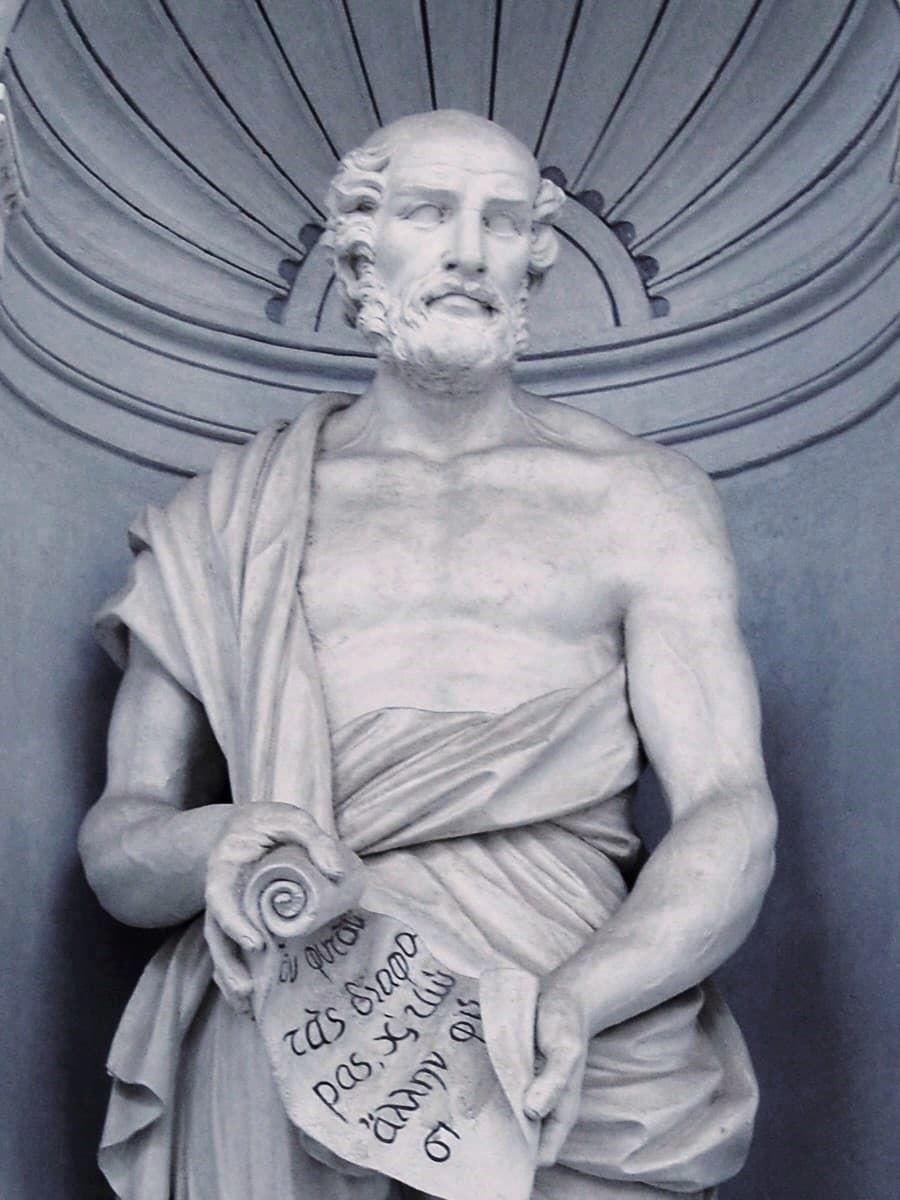
Theophrastus
Aristotle's successor and the 'father of botany.'
Overview
Aristotle's closest pupil and chosen successor, Theophrastus led the Lyceum for some thirty-five years and extended Aristotelian science across every field. He effectively founded scientific botany with two great works, sharpened problems in metaphysics (questioning whether nature is everywhere purposeful), and wrote the Characters — thirty witty sketches of moral types that launched a literary genre. He also inherited and preserved Aristotle's library and writings.
What they supported — and why
Empirical botany
SupportedPlants form a systematic domain with their own principles of structure, growth, and classification.
WhyNature must be studied on its own terms; since Aristotle had catalogued animals, plants deserved the same rigorous, observational treatment.
Doubts about universal teleology
SupportedNot everything in nature exists for a purpose; some features are byproducts with no end.
WhyStrict, all-encompassing teleology overreaches — some phenomena are better explained without appealing to purposes.
Observing human character
SupportedMoral dispositions can be catalogued through the small, telling behaviors of everyday life.
WhyCharacter shows itself in habitual trifles, so vivid types illuminate ethics more concretely than abstractions.
Causes championed
- Empirical natural science
- Systematic classification
- The study of human character
Issues wrestled with
- How should living things be classified?
- Is all of nature purposeful?
- What are the recurring types of moral character?
Hurdles faced
- Sustaining and funding the Lyceum after its founder
- Safeguarding Aristotle's manuscripts for posterity
Works & books
4 catalogued. Status shows how much survives to today.
Enquiry into Plants
SurvivesThe founding work of systematic botany — description and classification of plants.
On the Causes of Plants
SurvivesCompanion work on plant physiology, growth, and propagation.
Characters
SurvivesThirty sketches of moral types (the Flatterer, the Boor, the Superstitious Man…) that founded a literary genre.
Metaphysics
PartialA short aporetic essay raising sharp difficulties for Aristotelian teleology.
Read the texts free
1 of Theophrastus’s works are free to read in full — public-domain English editions on Project Gutenberg, matched from Gutenberg’s own catalogue.
Every edition online — Open Library catalogues 197 works & editions, 34 of them free to read in full.
The influence network
See Theophrastus in the map →In their words
“Time is the most valuable thing a person can spend.”
— attributed via Diogenes Laërtius
Legacy
He founded scientific botany, preserved and organized Aristotle's legacy, and with the Characters created a literary form still imitated today.
Further reading
Cross-checked against these authoritative references.