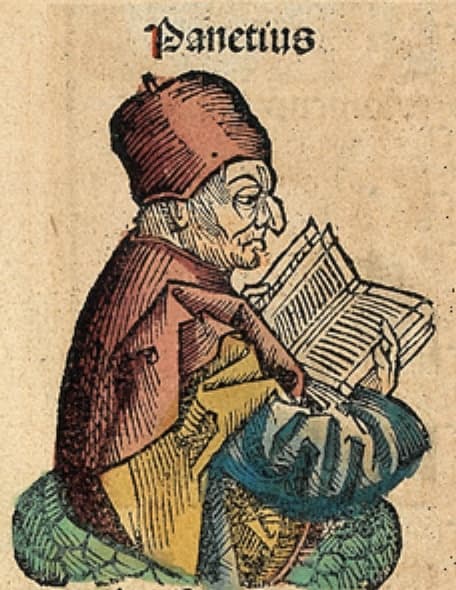
Panaetius of Rhodes
Founder of Middle Stoicism who softened the Stoa and carried it to Rome.
Overview
Head of the Stoa and founder of 'Middle Stoicism', Panaetius adapted Stoic doctrine for a Roman audience, making it more practical and humane. He softened rigid orthodoxy — doubting the periodic cosmic conflagration, rejecting divination and astrology, and stressing concrete duties over the ideal of the perfect sage. Through his friendship with the Scipionic circle and his treatise On Duties (the model for Cicero's De Officiis), he shaped Roman ethics for centuries.
What they supported — and why
A practical ethics of duty
SupportedFocus on 'appropriate actions' (kathēkonta) suited to real people and their roles, not only the unattainable ideal of the sage.
WhyOrdinary people making moral progress need concrete guidance, so ethics should address the duties of actual life.
The four personae (roles)
SupportedEach person combines universal human reason, an individual nature, particular circumstances, and a chosen vocation.
WhyRight action depends on who one is and where one stands, so morality must take account of individual roles.
A moderated Stoic physics
SupportedHe doubted the cosmic conflagration and rejected divination and astrology.
WhyThese doctrines were speculative or superstitious, and a credible philosophy should not rest on them.
Causes championed
- A humane, practical Stoicism
- Duty in real life
- Greek philosophy adapted for Rome
Issues wrestled with
- How should ordinary people — not only sages — act?
- What are our duties?
- Which Stoic doctrines are defensible?
Hurdles faced
- Revising revered Stoic orthodoxy
- Translating Greek ethics into the terms of Roman public life
Works & books
2 catalogued. Status shows how much survives to today.
On Duties
LostThe lost work that became the basis of Cicero's De Officiis.
On Providence; On Cheerfulness
LostEthical and physical treatises, known only through later reports.
Read the texts free
Their works online — Open Library catalogues 7 works & editions.
The influence network
See Panaetius of Rhodes in the map →Influenced by
Influenced
In their words
“We are not born for ourselves alone.”
— via Cicero, De Officiis, drawing on Panaetius
Legacy
He made Stoicism livable and Roman; through Cicero's De Officiis his ethics of duty shaped Western moral thought into the modern age.
Further reading
Cross-checked against these authoritative references.