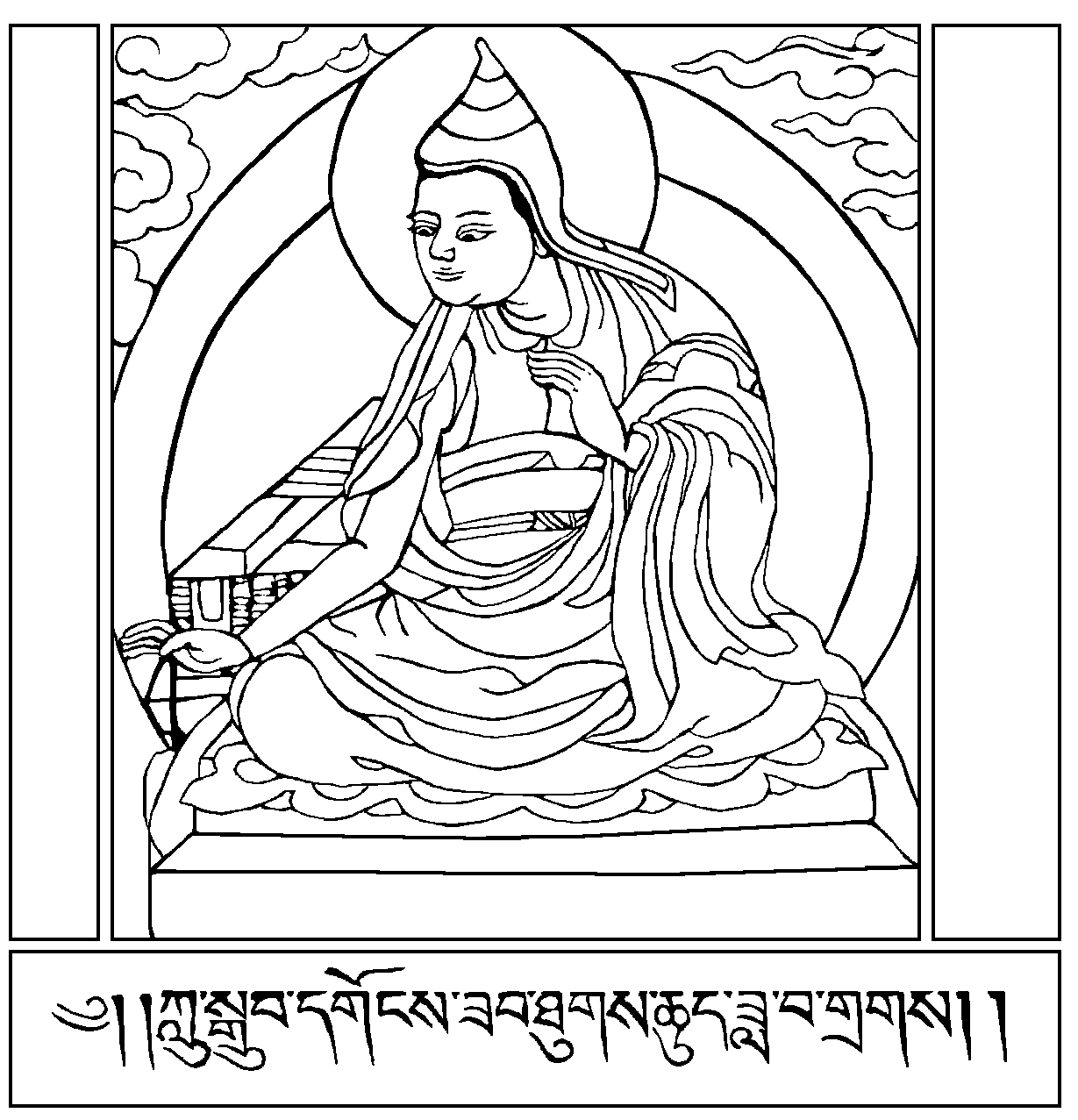
Dharmakīrti
The greatest Buddhist logician — perfected the epistemology of perception and inference.
Overview
The most important Buddhist epistemologist, who worked at the great monastic university of Nālandā and built on Dignāga to create a rigorous system of logic and epistemology (pramāṇa) that became standard for Buddhist philosophy and a formidable challenge to Hindu and Jain thinkers. In the Pramāṇavārttika he refined the theory of the two valid means of knowledge, defended nominalism (apoha) and momentariness, gave a causal theory of perception, and argued that what is real is what has causal efficacy. His work dominated later Indian and Tibetan philosophy.
What they supported — and why
Two means of knowledge, refined
SupportedPerception (immediate, non-conceptual, caused by the object) and inference are the only valid sources of knowledge.
WhyKnowledge must be causally connected to reality and capable of guiding successful action, so only these two sources qualify.
Causal efficacy is the mark of the real
SupportedWhat is ultimately real is the momentary particular defined by its power to produce effects (arthakriyā).
WhyTo be is to be able to act; only fleeting particulars have this power, while stable universals are conceptual constructs.
Apoha (meaning by exclusion) and momentariness
SupportedUniversals are mental constructs formed by excluding 'the other', and real things perish the moment they arise.
WhyOnly unique momentary particulars are real, so general concepts must be the mind's way of grouping by negation.
Causes championed
- Rigorous epistemology
- A defensible Buddhist nominalism
- The reliability of knowledge for action
Issues wrestled with
- What are the valid sources of knowledge?
- What is ultimately real?
- Do universals exist?
Hurdles faced
- Defending Buddhism against a resurgent Hindu logic (Nyāya)
- His dense work needing centuries of commentary
Works & books
2 catalogued. Status shows how much survives to today.
Pramāṇavārttika (Commentary on Valid Cognition)
SurvivesHis masterwork of Buddhist logic and epistemology (preserved in Sanskrit and Tibetan).
Nyāyabindu (Drop of Logic)
SurvivesA concise manual of his epistemology.
Read the texts free
Their works online — Open Library catalogues 68 works & editions, 3 of them free to read in full.
The influence network
See Dharmakīrti in the map →Influenced by
Influenced
In their words
“Whatever has causal efficacy is ultimately real.”
— paraphrase of the Pramāṇavārttika
Legacy
He brought Buddhist logic and epistemology to its summit; his system remains central to Tibetan monastic education fourteen centuries later.
Further reading
Cross-checked against these authoritative references.