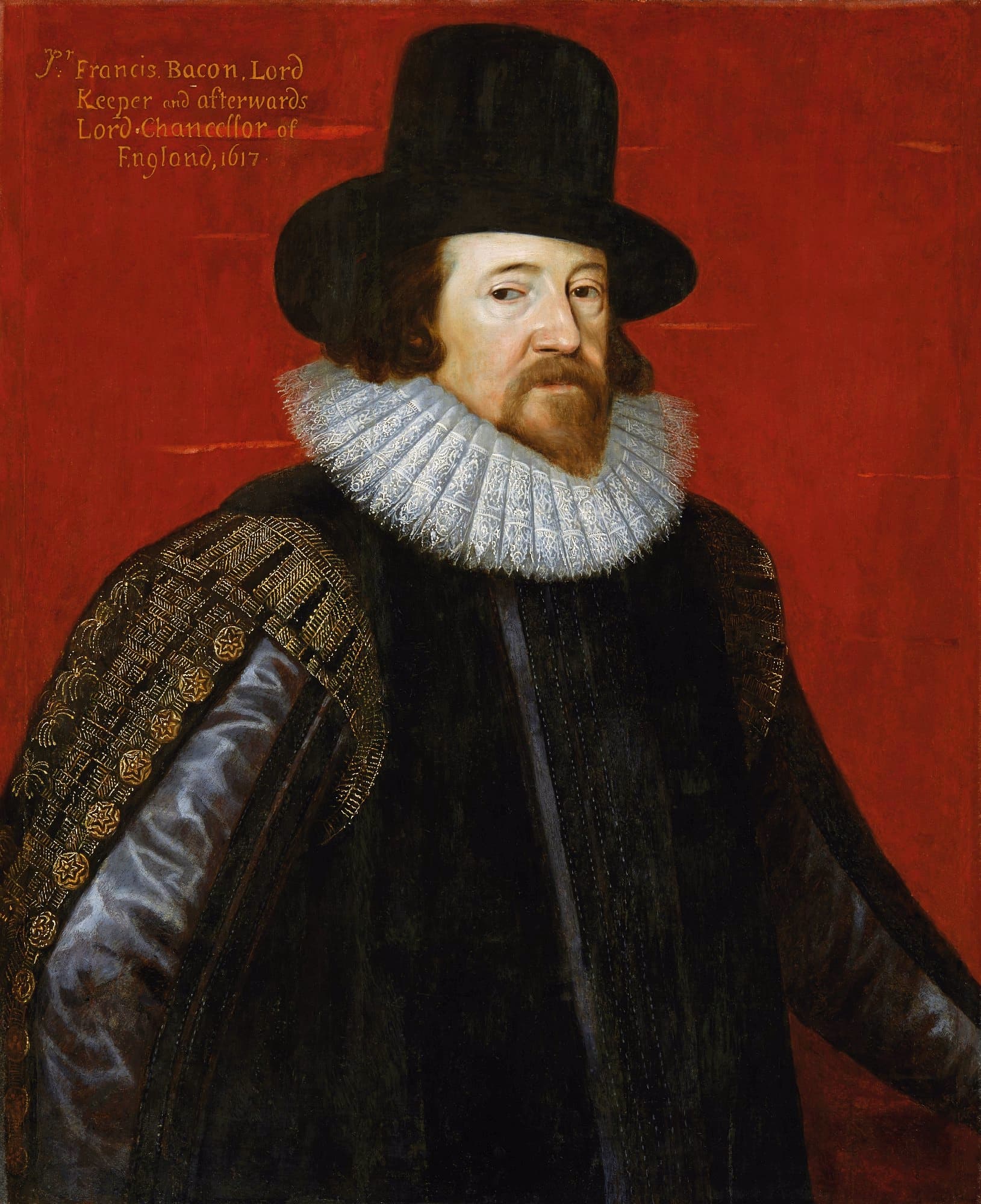
Francis Bacon
Prophet of the scientific method — knowledge is power, built from experiment.
Overview
An English statesman, essayist, and philosopher of science, Bacon called for a wholesale reform of knowledge based on systematic observation and experiment rather than deference to Aristotle. In the Novum Organum he set out a method of induction — gathering data and eliminating false explanations — to discover nature's laws, and warned against the 'idols' that distort the mind. He envisioned science organized for the collective benefit of humanity, becoming a founding prophet of the scientific revolution and the empiricist tradition.
What they supported — and why
Inductive method
SupportedBuild knowledge upward from careful, organized observation and experiment, eliminating false hypotheses, rather than deducing from unexamined first principles.
WhyThe old deductive logic multiplies error from bad premises; only patient induction from nature's facts yields real, reliable knowledge.
The idols of the mind
SupportedGuard against systematic distortions — idols of the tribe, cave, marketplace, and theatre — that bias human understanding.
WhyThe mind is not a clear mirror; naming its inherent biases (from human nature, individual quirks, language, and dogma) helps correct them.
Knowledge is power, for human benefit
SupportedThe aim of science is to understand nature so as to improve the human condition.
WhyGenuine knowledge of causes gives command over nature, so learning should be pursued for practical good, not mere disputation.
Causes championed
- The reform of knowledge
- Experimental science for human welfare
- Organized, collaborative inquiry
Issues wrestled with
- How is genuine knowledge gained?
- What distorts human understanding?
- What is knowledge for?
Hurdles faced
- Entrenched Aristotelian and Scholastic authority
- A political downfall — impeached for bribery as Lord Chancellor
Works & books
2 catalogued. Status shows how much survives to today.
Novum Organum (The New Organon)
SurvivesHis method of induction and the doctrine of the idols of the mind.
The Advancement of Learning; New Atlantis
SurvivesA survey and reform of the sciences, and a utopia of organized research.
Read the texts free
8 of Francis Bacon’s works are free to read in full — public-domain English editions on Project Gutenberg, matched from Gutenberg’s own catalogue.
Every edition online — Open Library catalogues 1,666 works & editions, 266 of them free to read in full.
The influence network
See Francis Bacon in the map →Influenced by
Influenced
In their words
“Knowledge itself is power.”
— attributed to Bacon
Legacy
He gave the scientific revolution its manifesto; his experimental method and vision of science for human good shaped the modern world.
Follow their questions
This thinker is a stop on these paths through philosophy.
Further reading
Cross-checked against these authoritative references.