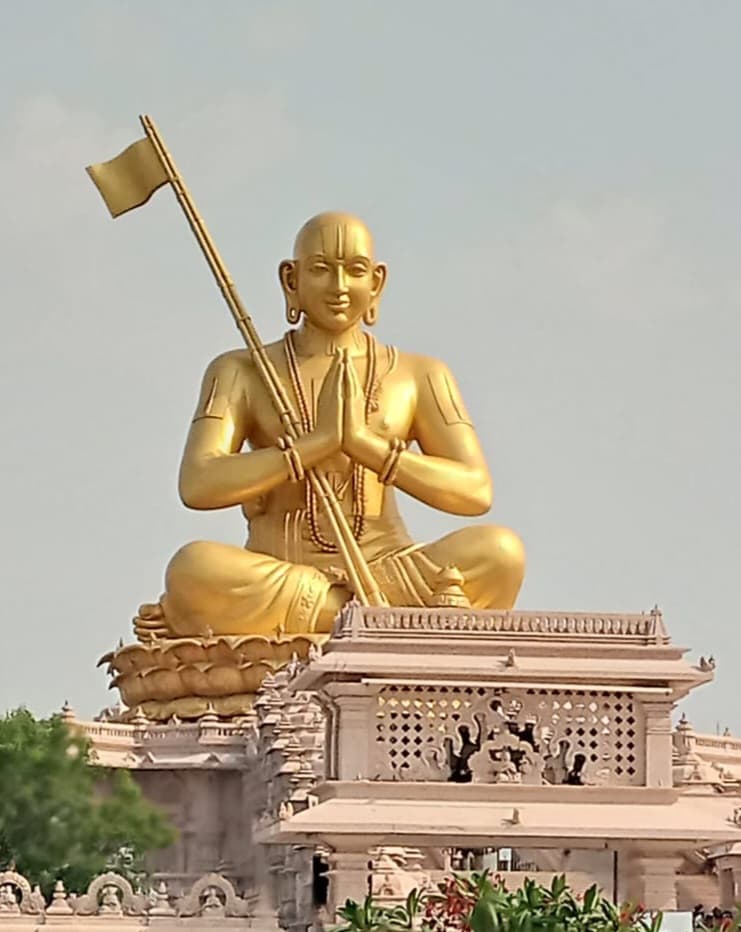
Rāmānuja
Founder of Vishishtadvaita — qualified non-dualism and a philosophy of devotion.
Overview
The foremost theologian of Vishishtadvaita ('qualified non-dualism') Vedānta and a champion of devotional (bhakti) religion. Against Śaṅkara's strict non-dualism, he argued that Brahman is a personal God (identified with Viṣṇu) who is one but qualified by real distinctions: individual souls and the material world are real and form the 'body' of God, related to him as attributes to a substance. Liberation comes through loving devotion and God's grace, not through knowledge alone.
What they supported — and why
Qualified non-dualism (Vishishtadvaita)
SupportedReality is one, but the one Brahman is internally qualified by real souls and matter, which are its inseparable modes or 'body'.
WhyScripture affirms both God's oneness and the reality of souls and world, so the truth is a unity-in-difference, not a bare identity.
Brahman is a personal God
SupportedThe ultimate is not impersonal consciousness but a loving, personal Lord with auspicious attributes.
WhyDevotion and grace require a personal God, and the texts describe Brahman as full of perfections, not as bare being.
Liberation through devotion (bhakti) and grace
SupportedThe soul reaches God through loving surrender and divine grace, keeping its individuality in blissful communion.
WhySince souls are real and distinct, liberation is loving union with God, not dissolution into an impersonal absolute.
Causes championed
- Devotional religion
- The reality of the soul and world
- A personal and gracious God
Issues wrestled with
- Is the absolute personal or impersonal?
- Are souls and the world real?
- How is liberation attained?
Hurdles faced
- Opposing the dominant Advaita of Śaṅkara
- Persecution that forced him into exile for a time
Works & books
2 catalogued. Status shows how much survives to today.
Śrī Bhāṣya (commentary on the Brahma Sūtras)
SurvivesHis major statement of qualified non-dualism.
Vedārtha Saṃgraha; Gītā Bhāṣya
SurvivesFurther expositions of theistic Vedānta and devotion.
Read the texts free
Their works online — Open Library catalogues 0 works & editions.
The influence network
See Rāmānuja in the map →Influenced by
Influenced
In their words
“The individual self is a real mode of the Supreme — distinct, yet inseparable from God.”
— paraphrase of Vishishtadvaita
Legacy
He gave devotional Hinduism its philosophical foundation and remains the central theologian of Śrī Vaiṣṇavism and theistic Vedānta.
Further reading
Cross-checked against these authoritative references.