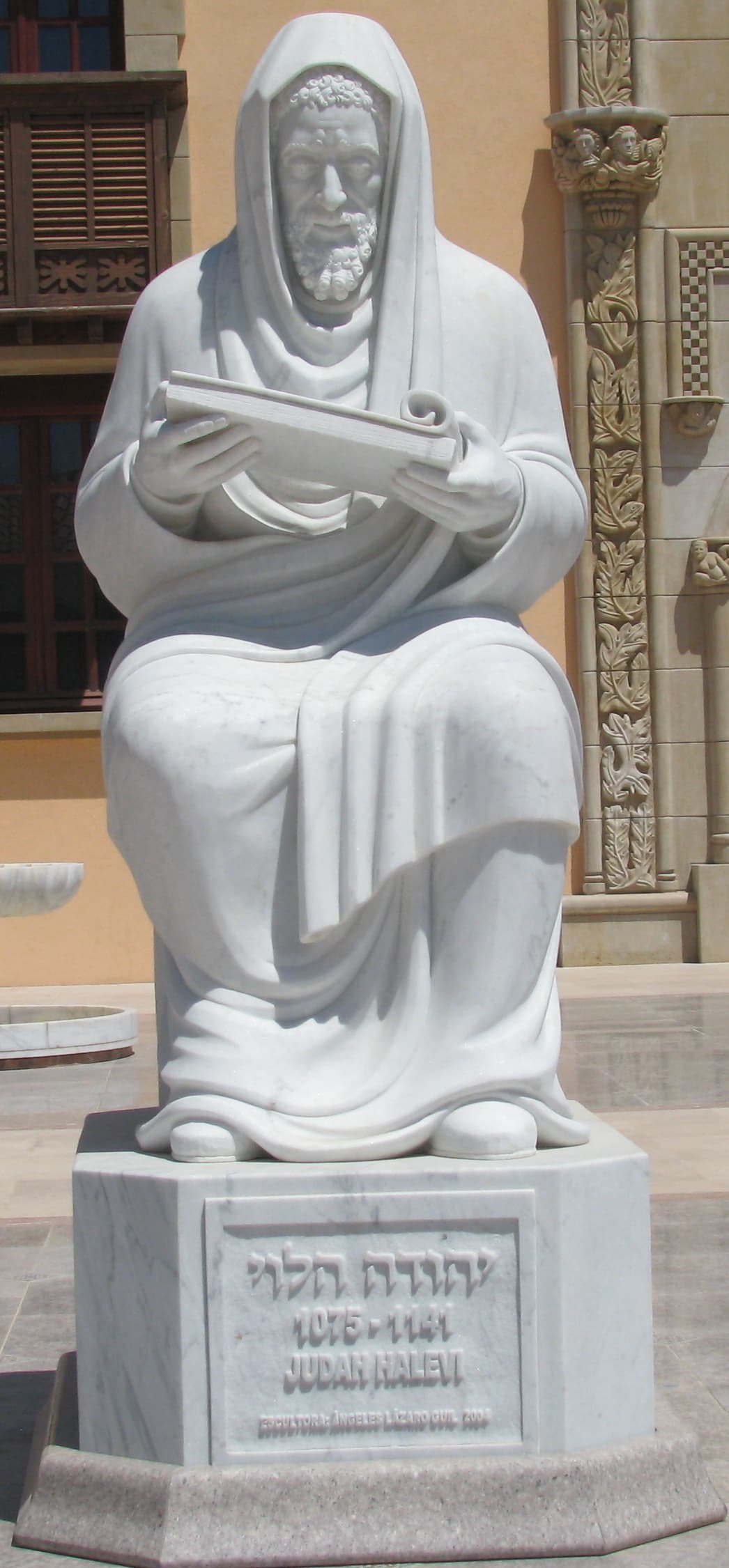
Judah Halevi
Yehuda ha-Levi
Poet who defended the God of Abraham against the God of the philosophers.
Overview
One of the greatest Hebrew poets and a distinctive philosopher, Judah Halevi wrote The Kuzari, a dialogue in which the king of the Khazars, seeking the true religion, is persuaded by a Jewish sage. Against the confident rationalism of the philosophers, Halevi defended a religion grounded in lived history and direct experience — the God of Abraham, revealed in the Exodus and to a whole people, over the abstract 'God of Aristotle' reached by argument. Late in life he journeyed toward the Land of Israel.
What they supported — and why
The God of Abraham over the God of Aristotle
SupportedThe living God known through history and revelation is superior to the abstract First Cause of the philosophers.
WhyReligion rests on the concrete, witnessed experience of a whole people (the Exodus, Sinai), giving a certainty and intimacy abstract argument cannot.
Revelation and the role of Israel
SupportedProphecy and the direct experience of God, given to Israel, are a distinct source of truth beyond reason.
WhyGod's self-disclosure in history provides knowledge unavailable to unaided philosophy.
The limits of philosophy
SupportedRational speculation cannot yield the certainty or the intimate God that revelation provides.
WhyThe philosophers disagree among themselves and reach only a remote deity, so reason alone is an insufficient foundation for religious life.
Causes championed
- Experiential, historical religion
- The defense of Judaism
- The love of the Land of Israel
Issues wrestled with
- Is the God of religion the God of the philosophers?
- What is the source of religious certainty?
- What is Israel's role?
Hurdles faced
- Writing amid the decline of Andalusian Jewry
- Leaving comfort to journey toward Jerusalem late in life
Works & books
2 catalogued. Status shows how much survives to today.
The Kuzari
SurvivesHis dialogue defending a religion of experience and history against philosophy.
Hebrew poetry (secular, devotional, and 'Songs of Zion')
SurvivesA celebrated body of verse, among the summits of medieval Hebrew literature.
Read the texts free
Their works online — Open Library catalogues 6 works & editions.
The influence network
See Judah Halevi in the map →Influenced by
Influenced
In their words
“The God of Abraham, Isaac, and Jacob is not the God of Aristotle.”
— paraphrase of The Kuzari
Legacy
He gave classic voice to a religion of experience and history against pure rationalism, and remains one of Hebrew literature's greatest poets.
Further reading
Cross-checked against these authoritative references.