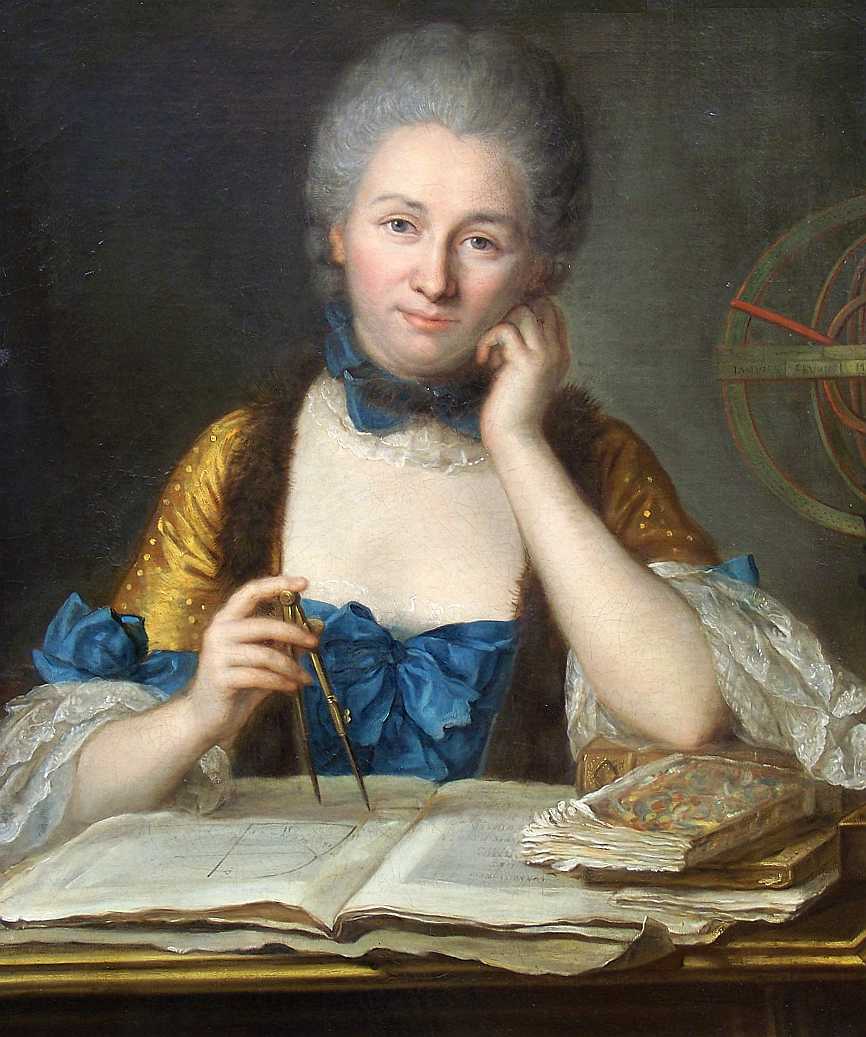
Émilie du Châtelet
Enlightenment physicist-philosopher who synthesized Newton and Leibniz — and 'living force'.
Overview
A French natural philosopher and mathematician, du Châtelet made original contributions to physics and metaphysics amid a world that barred women from academies. In her Institutions de Physique (Foundations of Physics) she synthesized Newtonian mechanics with Leibnizian and Cartesian metaphysics, seeking secure foundations for science. Her translation and commentary on Newton's Principia remains the standard French version. Building on Leibniz and 's Gravesande, she argued that 'living force' (vis viva) is proportional to mass times velocity squared — a step toward the concept of energy. She also wrote on freedom, happiness, and the foundations of knowledge.
What they supported — and why
Foundations for physics (Newton and Leibniz combined)
SupportedNewtonian science needs firm metaphysical foundations, best supplied by combining Newton's physics with Leibnizian principles (sufficient reason, living forces).
WhyEmpirical laws alone leave the grounds of science unsettled, so metaphysics and physics must be integrated to secure real understanding.
Living force (vis viva)
SupportedThe 'force' of a moving body is proportional to its mass times the square of its velocity (mv²), not simply its momentum.
WhyExperiments (dropping weights into clay) show effect scales with velocity squared, distinguishing 'living force' from momentum — a forerunner of kinetic energy and its conservation.
Happiness, freedom, and the life of the mind
SupportedA good life is built on the pursuit of knowledge, useful passions, and the cultivation of one's own happiness.
WhySince study and meaningful passion are the surest sources of contentment, especially for a woman excluded from public life, they are worth deliberate cultivation.
Causes championed
- The foundations of physics
- The integration of Newtonian and Leibnizian science
- Women's access to learning
Issues wrestled with
- What grounds physical science?
- How should 'force' and motion be measured?
- What makes a good and happy life?
Hurdles faced
- Excluded, as a woman, from universities and the Academy of Sciences
- Her achievements long overshadowed by her partnership with Voltaire
Works & books
3 catalogued. Status shows how much survives to today.
Institutions de Physique (Foundations of Physics)
SurvivesHer synthesis of Newtonian physics with Leibnizian and Cartesian metaphysics.
Translation and commentary on Newton's Principia
SurvivesStill the standard French translation of Newton's masterwork (published posthumously).
Discourse on Happiness
SurvivesA reflection on happiness, study, and the passions.
Read the texts free
Their works online — Open Library catalogues 21 works & editions, 2 of them free to read in full.
The influence network
See Émilie du Châtelet in the map →In their words
“Judge me for my own merits, or lack of them, but do not look upon me as a mere appendage.”
— attributed to du Châtelet
Legacy
A pioneering woman of science and philosophy whose synthesis of Newton and Leibniz, and her work on living force, fed directly into the modern concept of energy.
Further reading
Cross-checked against these authoritative references.