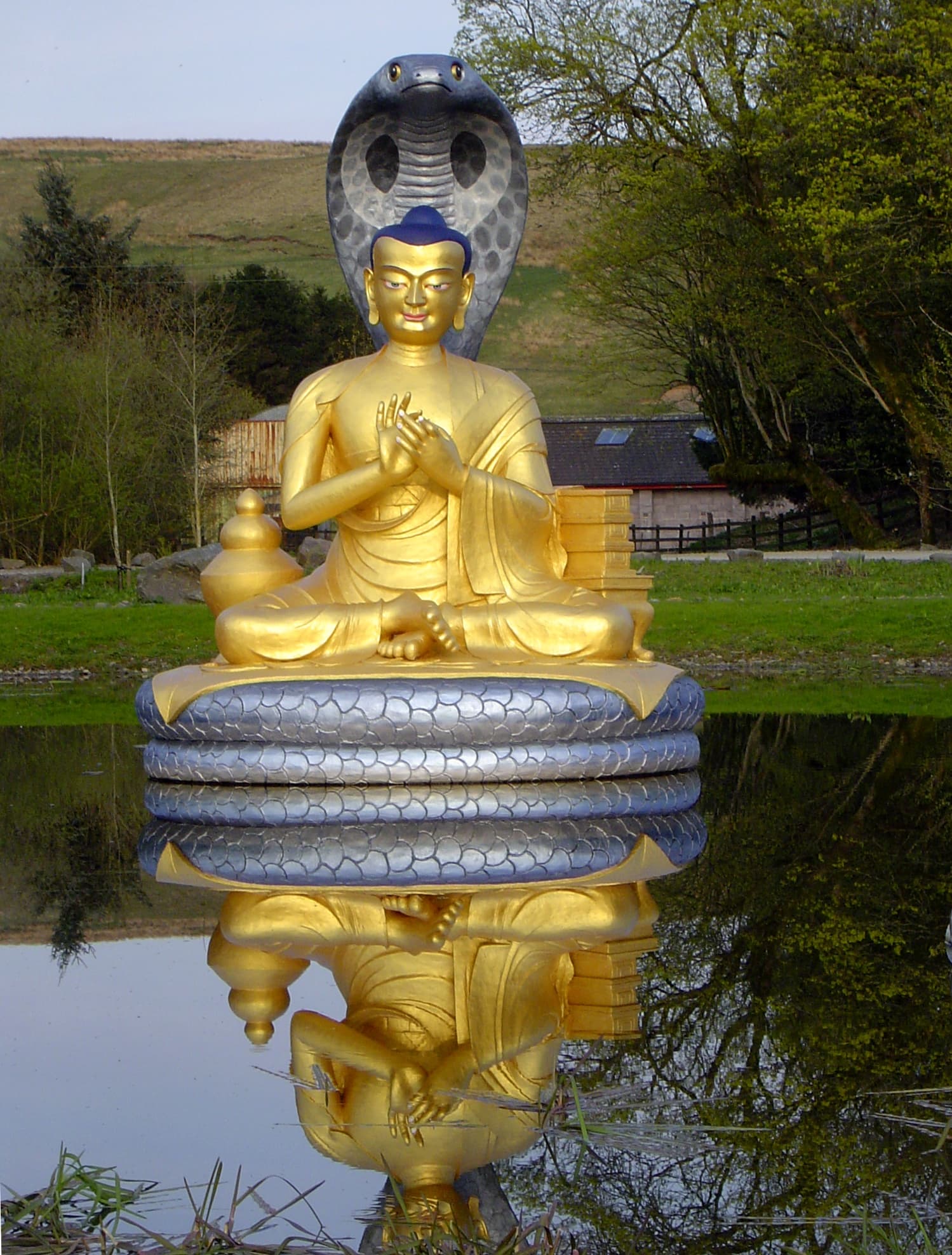
Nāgārjuna
Founder of Madhyamaka Buddhism — the philosophy of emptiness (śūnyatā).
Overview
One of the most important Buddhist philosophers and founder of the Madhyamaka ('Middle Way') school of Mahāyāna Buddhism. In the Mūlamadhyamakakārikā he argued that all things are 'empty' (śūnya) of inherent, independent existence (svabhāva): everything arises dependently and has no self-standing essence. He deployed rigorous reductio arguments against every fixed position, and articulated the doctrine of the two truths — conventional and ultimate — to reconcile emptiness with everyday reality without collapsing into nihilism.
What they supported — and why
Emptiness (śūnyatā)
SupportedAll phenomena are empty of svabhāva — inherent, independent existence.
WhyEverything arises in dependence on causes, conditions, and conceptual designation, so nothing possesses a fixed, self-standing essence.
The two truths
SupportedThere is conventional truth (the everyday world) and ultimate truth (emptiness); both are needed.
WhyEmptiness does not deny the conventional world but reveals its dependent nature; without the distinction one lapses into reification or nihilism.
The Middle Way beyond extremes
SupportedReject both 'existence' (things have essences) and 'non-existence' (nihilism).
WhyThings are neither absolutely real nor utterly unreal but dependently arisen, so truth lies between the extremes.
Causes championed
- The deconstruction of fixed essences
- The Middle Way
- Liberation through insight into emptiness
Issues wrestled with
- Do things have inherent existence?
- How can emptiness be reconciled with ordinary reality?
- How to avoid both reification and nihilism?
Hurdles faced
- The risk of emptiness being misread as nihilism
- Wielding argument to dissolve all positions without a new dogma
Works & books
2 catalogued. Status shows how much survives to today.
Mūlamadhyamakakārikā (Fundamental Verses on the Middle Way)
SurvivesHis masterwork arguing the emptiness of all phenomena through rigorous dialectic.
Vigrahavyāvartanī and other treatises
SurvivesReplies to objections and further expositions of emptiness.
Read the texts free
Their works online — Open Library catalogues 0 works & editions.
The influence network
See Nāgārjuna in the map →Influenced by
Influenced
In their words
“Whatever is dependently arisen, that is explained to be emptiness.”
— Mūlamadhyamakakārikā 24.18
Legacy
His philosophy of emptiness is the intellectual foundation of Mahāyāna Buddhism and one of the most rigorous analyses of dependence and essence in world philosophy.
Further reading
Cross-checked against these authoritative references.